
What if you were the Demon Lord, and the heroes marching on your castle were becoming stronger whether you interfered or not? In this seven-question written interview, developer Jun Tae Park of two-person team Spacewisp Games explains the unusual design logic behind Against Heroes: growth that makes sense within the world, army combinations that matter more than tiny bonuses, and an autobattler where choosing the wrong target can be disastrous.
The game has a public Steam demo. A full Windows PC launch was planned for 10 November 2026 at the time of the interview; dates may change. This feature reports the developer’s account rather than hands-on review findings.
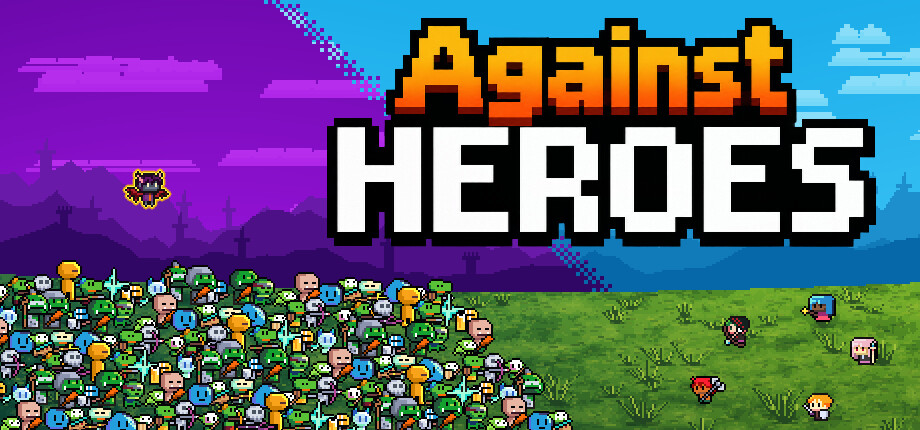
Written developer interview: seven questions from Coloured Static Press; original answers from Jun Tae Park, Spacewisp Games. Editorial presentation has been adjusted only for paragraph spacing and legibility. This is not a scored review.
The full developer interview
Note from the developer: the game was made by two people; the interviewee uses “I” when describing its design and development for ease of reading.
1. Where did the idea for Against Heroes come from, and what appealed to you about putting players in the Demon Lord’s position?
I’ve always liked games where your enemies grow stronger while you’re busy doing other things. It makes the world feel alive, as if things are happening independently of the player.
On the other hand, I really dislike level scaling, where enemies become stronger simply because the player has leveled up. I prefer enemies to grow stronger for reasons that make sense within the game world.
I wanted to create a game where enemies would grow stronger over time, and the player’s challenge would be to decide how and when to stop them.
The idea of playing as a Demon Lord hunting down heroes turned out to be a natural fit for that concept. Heroes are supposed to grow stronger through their adventures, so it makes sense that a Demon Lord would want to eliminate them before they become too powerful.
What appealed to me most was the asymmetry of the conflict. You start in a position of overwhelming power as the Demon Lord, but gradually begin to feel threatened by the heroes as they grow stronger and make their way toward your castle. I found that reversal of power, and the growing tension it creates, particularly interesting as a concept.
In other words, playing as the Demon Lord wasn’t the starting point. It was the setting that best suited the game I wanted to make.
2. How do you make the strategy decisions meaningful within an autobattler, where combat is largely automated?
I designed unit matchups and abilities to create dramatic differences on the battlefield.
For example, even a melee hero with overwhelming stats becomes helpless if they can’t reach their target, so slowing them down can be an extremely effective strategy. On the other hand, a hero who relies on rapid attacks to deal high cumulative damage might find themselves completely ineffective against heavily armored units.
By giving each unit clearly defined strengths and weaknesses, I wanted army composition and positioning to be capable of completely turning the outcome of a battle around.
I also deliberately chose additive bonuses over multiplicative ones. A flat bonus of just a few points can make an enormous difference when the original value is small. The damage formula is equally straightforward: Attack minus Defense. Even a difference of just one point can drastically change how effective a unit is.
This is a characteristic I particularly enjoy in a genre known as Magic Tower in China and WWA-style games in Japan.
I took a similarly extreme approach to status effects and debuffs. Instead of reducing an enemy’s defense by 50%, you can reduce it all the way to zero. Instead of merely slowing their attack speed, you can prevent them from attacking entirely.
The idea is to make tactical decisions matter far more than small statistical advantages. Even though the battles play out automatically, the right combination of units and abilities can completely change the result.
3. What was your approach to designing the opposing heroes so that each encounter presents a different tactical challenge?
I designed the heroes to gradually overcome their own weaknesses as they level up.
For example, a melee hero who is initially vulnerable to slowing effects might eventually become immune to them. Similarly, a ranged hero who struggles against enemies at close range might learn a powerful area-of-effect attack that can wipe out nearby enemies.
As a result, even when facing the same hero, players may need a completely different strategy depending on how far that hero has progressed.
On top of that, heroes can equip different combinations of items, adding another layer of unpredictability.
But perhaps the most important part is that players aren’t guaranteed to have access to the tools they need to counter a particular hero.
Knowing an enemy’s weakness is one thing. Having the right units or abilities available to exploit it is another. Players have to work with whatever options they’ve managed to acquire, sometimes finding unconventional solutions when the ideal counter simply isn’t available.
My goal was to make each encounter a problem that players have to solve with the resources they actually have, rather than a puzzle with a guaranteed solution.
4. How do players develop their strategy and adapt after a failed battle?
In the early stages of the game, losing a battle doesn’t immediately end your run. Players are given multiple opportunities to retry, and in the very beginning, retries are effectively unlimited.
The idea is to encourage players to learn about their opponents through failure and experiment with different strategies without being heavily punished for it.
Even if players can’t defeat a particular hero right away, they can continue progressing, unlock new monsters and skills, and discover new synergies that might give them a better chance in future encounters.
This is also why I introduced a mechanic called the Revenge Bonus.
During development, I noticed something interesting about my own behavior. Whenever I realized that no matter what combination I tried, I simply couldn’t defeat a particular hero, I would sometimes just force-close the game. I didn’t think that was a healthy response for the game to encourage.
I wanted players to feel that letting a hero escape wasn’t necessarily a failure, and could even work to their advantage.
So I introduced a system where defeating a hero who previously escaped grants additional experience points. The more opportunities you pass up to defeat that hero, the greater the reward for eventually taking them down.
This changes the decision from “I failed to defeat this hero” to “Maybe I’ll come back for this hero later, when I have a better strategy.”
Interestingly, I originally wanted to avoid having a tutorial altogether. But I eventually decided to include one largely because I felt this particular mechanic was too important to leave unexplained.
5. Which mechanics required the most testing or balancing during development?
The most challenging part was giving each monster unit a unique identity with clearly defined strengths and weaknesses.
Each monster needed to have a meaningful role on its own, but at the same time, combining different monsters had to create powerful synergies. On top of that, these combinations also needed to interact meaningfully with the Demon Lord’s unique abilities.
Balancing these three layers—individual unit identity, synergies between monsters, and interactions with the Demon Lord’s abilities—required more testing and fine-tuning than anything else in the game.
Actually, I came up with a lot of ideas that I thought would be incredibly fun, but many of them had to be cut because I couldn’t find a way to balance them properly.
If I ever get the chance, I’d love to introduce something like a “Chaos Mode,” where I could bring back all those discarded ideas without worrying too much about balance.
It might be completely broken, but that could be part of the fun!
6. How did you decide what to include in the public demo, and what have players taught you so far?
Deciding how much content to include in the public demo was actually quite straightforward.
I wanted players who enjoyed the demo to become curious about what kinds of heroes they would encounter at higher difficulty levels, and hopefully consider buying the full game to find out.
With that in mind, I decided to let players experience difficulty levels 0 through 2, with two Demon Lords available from the start and a third unlocked after their first victory.
However, there was one decision I struggled with a great deal: should I let players choose between two Demon Lords right from the beginning, or only offer one?
Personally, I wanted to offer two. It’s just cooler that way, isn’t it?
But there was a significant problem. I really didn’t want players to lose their very first battle.
With the first Demon Lord, this wasn’t an issue. He doesn’t have particularly powerful special abilities, but he starts with a wide variety of tools. Combined with unlimited retries, this means players can defeat any hero in their first battle, as long as they’re willing to keep experimenting.
The second Demon Lord, however, specializes in deploying large numbers of smaller units. Unfortunately, about 14% of the heroes are defensive types that this particular army simply cannot defeat in the opening battle, no matter what strategy the player tries.
Losing that first battle doesn’t actually prevent players from winning the overall run. It’s a perfectly recoverable situation.
But I was worried that some players might quit the game right then and there.
I’ve spent a long time working in mobile game development, where preventing players from quitting during their first few minutes is extremely important. So this was something I took very seriously.
I considered several solutions, including locking the second Demon Lord at the beginning or simply labeling the first Demon Lord as the recommended choice.
In the end, though, I decided to do neither.
After all, this is Steam, where there are plenty of players who happily crank every difficulty setting in Battle Brothers to the maximum and dive right in!
More importantly, I realized that if losing the very first battle was enough to make someone give up, they probably wouldn’t enjoy the challenges I had designed for difficulty level 3 and beyond, especially from level 6 onward.
Rather than having someone buy the full game only to discover that its difficulty wasn’t what they expected, I felt it would be better for them to discover that during the demo.
So I left the choice as it was.
I wanted the demo not only to show players what Against Heroes has to offer, but also to help them decide whether it’s the kind of challenge they would actually enjoy.
As for what I’ve learned from players so far, I think it’s still a little too early to draw any major conclusions. The full game hasn’t been released yet, and I’d like to see how more players approach it before making any judgments.
7. What would you most like players to discover in the full game, and what has making it taught you personally?
More than anything, I hope players discover that Against Heroes requires a lot more strategy than it might appear to at first glance.
I sometimes wonder whether difficulty level 6 might actually be closer to what the average Steam player would enjoy. Having spent so many years in the mobile game industry, perhaps I’m still influenced by that experience and made the early difficulty levels a little too easy.
But that doesn’t mean I consider Against Heroes an extremely difficult game, either.
As I mentioned earlier, the game uses additive bonuses, and the real key to victory is learning how to exploit them to create combinations that are practically invincible. Once you discover the right synergies, you can overwhelm even the most troublesome heroes, regardless of their special mechanics.
I’m still not entirely sure how best to communicate that appeal to potential players.
In any case, my greatest hope is that players will clear every difficulty level and then come back to tell me, “That was too easy! Give us something harder!”
There are so many mechanics I came up with but was too afraid to include because of balancing concerns. I’d love to have an excuse to bring some of them back!
As for what making this game has taught me personally, I’ve learned just how important it is to prepare well in advance for a Steam release.
During the recent surge in Steam developer registrations, my own registration schedule ended up being delayed by around 40 days in total. As a result, I wasn’t even able to participate in Steam Next Fest before launch.
At the same time, I felt it would be strange to finish a game and then leave it unreleased for another five months just to accommodate a better promotional schedule.
Looking back, I realize that developing a game and preparing to release it successfully on Steam are two very different challenges.
Hopefully, I’ll be much better prepared next time!
Discover the game
Explore our original First Signal feature on Against Heroes for the developer’s initial pitch and context. This interview is independently edited, and no payment or favourable coverage is implied.
Answers received 28 October 2026. Artwork supplied from approved official promotional materials. Release timing remains planned 10 November 2026 as described above; check the official storefront for current availability.