
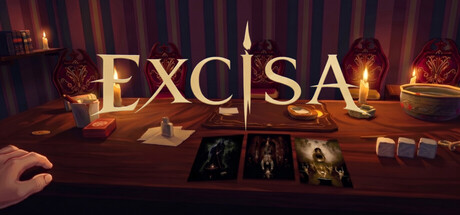
Five chairs. Eleven uninvited Guests. One question that an Angel must answer truthfully. EXCISA, the occult horror roguelite from independent studio zooyos, makes the player’s decisions the centre of its scares, all without leaving a single séance table.
For Coloured Static Press, the team behind EXCISA explains why danger comes to the player, how dice and blood sacrifices were rebalanced during development, and why learning the rules of the Guests matters as much as enduring the atmosphere. This is our original seven-question written developer interview, following our earlier First Signal discovery story.
Questions from Coloured Static Press; answers from zooyos, reproduced in the studio’s own words. No ending spoilers are included. This is an interview based on the developer’s responses, not a hands-on review or review score. EXCISA was scheduled for release on Windows PC on 29 October 2026.
The full developer interview
1. What inspired a horror game set entirely at a séance table, and why an Angel who always tells the truth?
The original idea behind EXCISA was to create a horror game where the tension comes from the player’s own decisions rather than from exploring different locations or running away from danger.
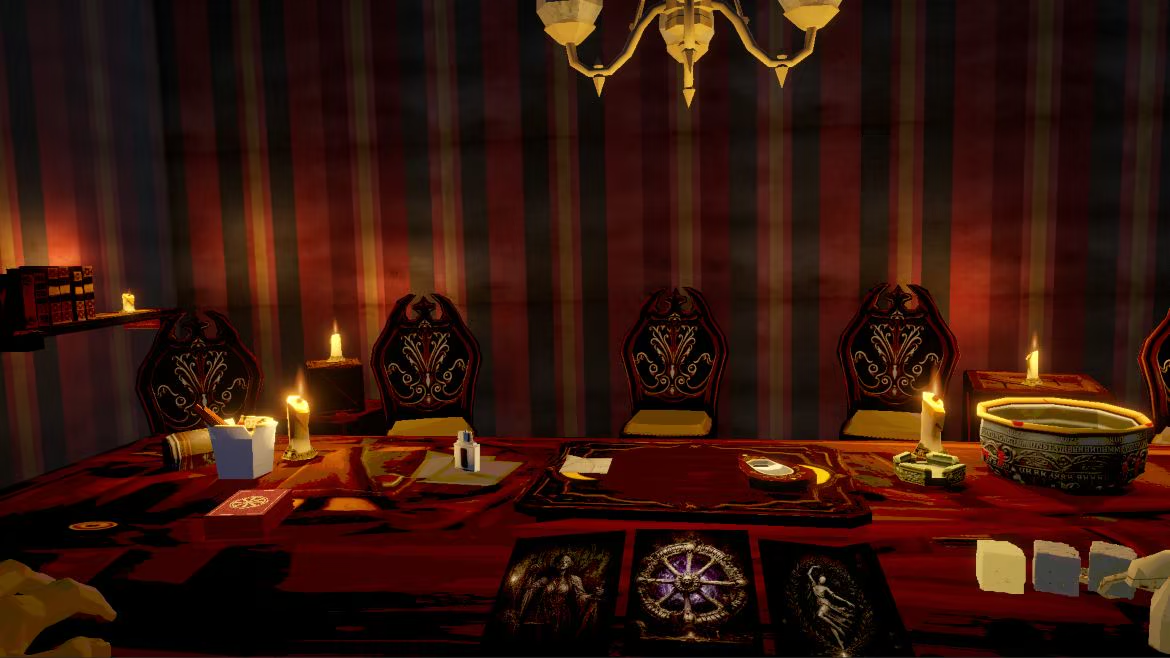
We liked the idea of having the player stay seated at a single table throughout the game. Instead of going out looking for danger, the danger comes to them. And they’re the ones who invite it in by lighting the candles and starting the ritual. A séance felt like a natural fit because it’s built around uncertainty: you never really know what might answer your call.
Tarot cards and dice gave us a way to bring that uncertainty into the gameplay. Every decision can bring a reward, but it can also have consequences.
The Angel gives the whole ritual a clear goal. It always tells the truth, but the path to that truth is far from simple. We liked that contrast: the player knows what they’re looking for, but not what price they might have to pay for it.
2. How does Anna’s search for her brother fit into a replayable roguelite without spoiling the ending?
Anna’s story gives the whole ritual a personal stake. She finds the instructions for the ritual on an internet forum and goes to the abandoned house hoping to find out what happened to her brother. It helps explain why someone might be willing to take such a risk for a single answer.
But the game isn’t about replaying Anna’s story. After Anna, it’s the player’s turn at the séance table, and from that point on, their decisions shape how the ritual unfolds.
It was important to us that each new run remained interesting on its own. We didn’t want the story to keep interrupting the flow of the game. Instead, we focused on giving players new decisions to make, Guests to adapt to, and the freedom to decide how much risk they’re willing to take.
As for what happens when the player finally reaches the Angel, we’d rather let them discover that for themselves.
3. How did you balance the safer one- or two-dice rolls against the need to risk three dice to advance?
One of our main ideas was that players shouldn’t have to rely on luck alone. We wanted them to constantly weigh the consequences of their decisions.
Choosing a tarot card means deciding what kind of reward they might get and what danger they could face. Then players choose how much risk to take by deciding how many dice to roll. With one or two dice, they can earn money, healing, blessings, and various tools to help them prepare. But to move forward, they have to roll three dice and get a MAJOR result.
During testing, we focused on finding a balance where preparing was worthwhile, but putting off the bigger risk also came at a cost. At one point, combining luck gained through blood sacrifices with three-dice rolls turned out to be too powerful. Rather than introduce extra restrictions to prevent that strategy, we increased the cost of blood sacrifices so that gaining a greater advantage also required a real sacrifice.
On top of that, every action burns down the candles, and every roll makes noise, so even the seemingly safer choices aren’t completely risk-free. Players constantly have to decide whether it’s worth gathering more resources or whether it’s time to take the bigger risk.
We wanted rolling three dice to feel like more than just a gamble. The blessings players acquire, the curses they’re carrying, and how they manage their resources all play a part in their chances on the next roll.
4. There are only five chairs, but eleven uninvited Guests. How did you make each one distinctive?
We wanted the Guests to be more than just horror characters with different appearances. Each one needed to present a different kind of challenge.
All eleven Guests follow their own rules. One only moves when the player tries to get closer to the Angel, while another calls an additional Guest to the table. So players have to pay attention not just to who’s arrived, but also to how each Guest behaves and how to deal with their presence.
Having only five chairs adds another layer of tension. It matters who’s already sitting at the table and whether there’s room for anyone else. A full table can be dangerous in its own right.
We also liked the idea that the player stays in the same room throughout the game, yet every new Guest can change the situation. One moment a chair is empty, and the next, someone is sitting there, forcing the player to adapt. We wanted players to feel that learning about the Guests and figuring out how to deal with them was part of the horror experience, not just a way to survive.
5. Why use blood, candles and changes in the room as danger indicators rather than conventional meters?
With a traditional health bar, players can simply look at it and see how much health they have left. We wanted them to focus more on the séance table and everything happening around it, and to sense danger through changes in their surroundings. Since the entire game takes place in one room, we felt it was important for the room itself to communicate information.
That’s why we built several important indicators directly into the game world. Blood on the player’s hands and changes in the room’s colors reflect their health. The candles show how much time is left, while the heartbeat warns players when their fear starts to get out of control.
We wanted these details to do more than just add to the horror atmosphere. They also needed to help players make decisions. It’s not just the Guests and the dice they have to watch, but also how the room changes around them.
The challenge was making these signals clear and easy to recognize while keeping them a natural part of the game’s atmosphere.
6. How do you make cursed objects and the option to bank a score compelling risks rather than frustrating penalties?
We think a risky decision becomes interesting when players understand what they stand to gain and what they might lose. We wanted the consequences to feel like the result of players’ own decisions, rather than arbitrary punishment.
Cursed objects are a good example. They can offer useful benefits, but they also make every dice roll worse. Players can choose to keep them for their advantages or give up a turn to get rid of the curse. Either choice comes at a cost.
Players face a similar decision between Depths. Their goal is to make it through all six and reach the Angel. But after completing each Depth, they can choose to stand up from the table and bank their score, or continue the ritual and move closer to the Angel, risking everything they’ve achieved up to that point.
We wanted to avoid having an obvious best choice every time. To us, risk-taking becomes truly interesting when both options make sense and players have to decide for themselves how far they’re willing to go.
7. What surprised you about demo players’ reactions, and what do you hope they discover beyond the horror?
Perhaps what surprised us most was how many different things players picked up on. We were especially happy to see them mention not just the horror atmosphere, but the game’s core concept and characters as well. We also received helpful feedback about how the text was displayed, which led us to introduce a more readable font, adjust the text size, and fine-tune how long text stays on screen.
Beyond the horror atmosphere, we’d love for players to discover the gameplay systems behind the ritual. There’s a lot in EXCISA they have to figure out for themselves: observing how Guests behave, learning their rules, recognizing how different mechanics work together, and gradually developing their own strategies.
We hope players will remember not only the scary moments, but also the satisfaction of overcoming something that once seemed difficult through what they’ve learned and the decisions they’ve made.
Discover EXCISA
EXCISA is listed on Steam. For official footage, promotional media and the studio’s spoiler guidance, visit the zooyos press kit. Our separate First Signal feature introduces the game without claiming hands-on review time.
Written interview answers received 29 October 2026. Original interview: Coloured Static Press. Official game image: zooyos. The developers’ promised Steam review key is a separate editorial matter and has not influenced this feature.