
Before the lights, the crowds and the music, there are train fares, awkward negotiations and difficult choices. For Łukasz Zaranek, those details are not just the background to a DJ’s career. They are the reason he built LIFE LIKE A DJ, a browser-playable management game about finding a path through the electronic music business.
Zaranek, a longtime DJ and producer who releases music as AISHERR, traces the idea from school discos and journeys to clubs across Poland to his current work as mayor of Rogoźno. He spoke to Coloured Static Press about balancing bookings and finances, recreating the feeling of a live show and why a smaller opportunity can sometimes matter more than a big contract.
This is a written developer interview. The current browser build is playable here. The scope of a proposed PC edition is still in development, not a confirmed set of released features.
What first led you from making and performing electronic music to designing LIFE LIKE A DJ?
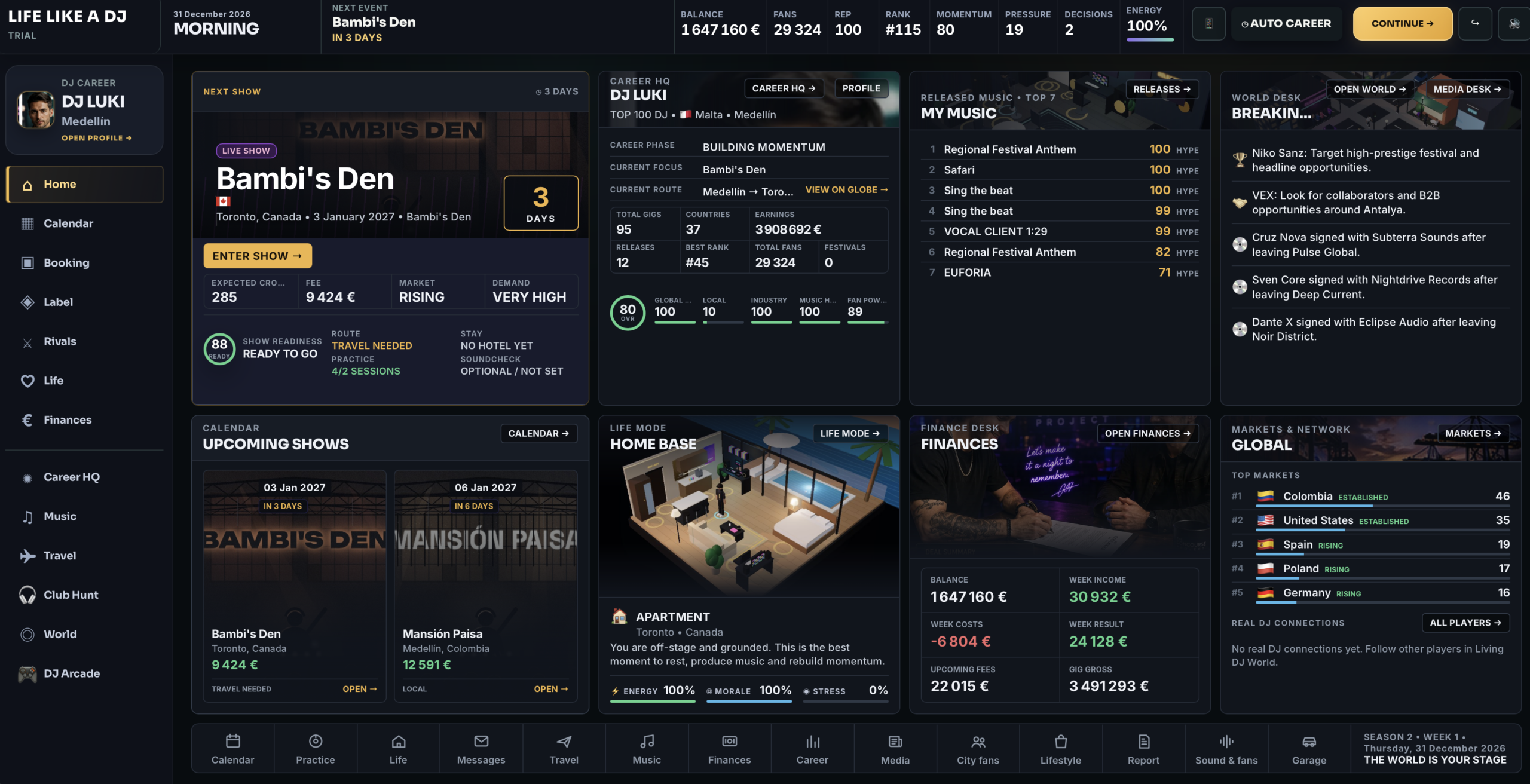
My story actually started at school discos. I played music for my classmates in primary school and continued doing so in secondary school. In 2001, while I was a university student, I spent my first scholarship money on a small DJ controller and some records. It was a modest beginning, but a huge investment for me.
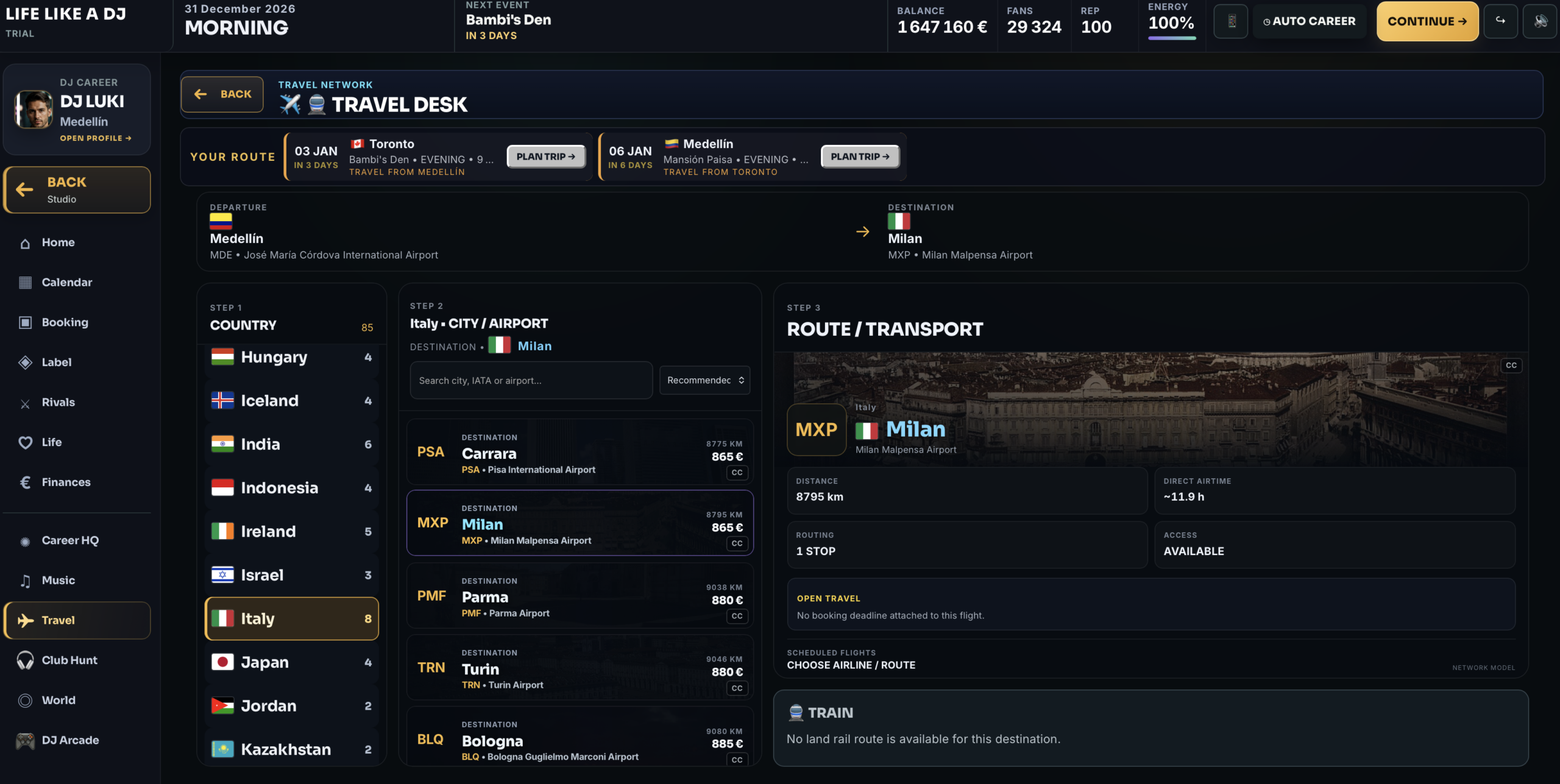
I began travelling by train to clubs across Wielkopolska, the region of Poland where I live. I often turned up uninvited and asked if I could play. There was no agent, no fee and certainly no glamorous backstage experience. Sometimes I played for free and paid my own train fare just for the opportunity to stand behind the decks.
Eventually I became a resident DJ in my hometown, Rogoźno. Then came smaller and larger events, work with local cultural centres, private functions I was persuaded to try, and later regional festivals and summer events. Over time I fell in love with Ableton and started making my own music. Some of my tracks, released as AISHERR, are on Spotify.
My professional life took a rather unexpected direction, too: today I’m the mayor of Rogoźno. It’s a demanding job, so time for my hobbies is limited. I began experimenting with AI tools as a way of building and creating more efficiently. One day, while making a small educational application for my eight-year-old son, I thought: why not try to make something I would love to play myself?
I’ve loved management games, tycoons and simulators since I was a teenager. Suddenly, I saw a way to combine that love with electronic music. I didn’t want a rhythm game. I wanted a game about building a DJ’s life and career, from the uncertain first opportunities onwards. That idea became LIFE LIKE A DJ.
Which realities of a working DJ’s career did you particularly want to represent beyond the live performances?
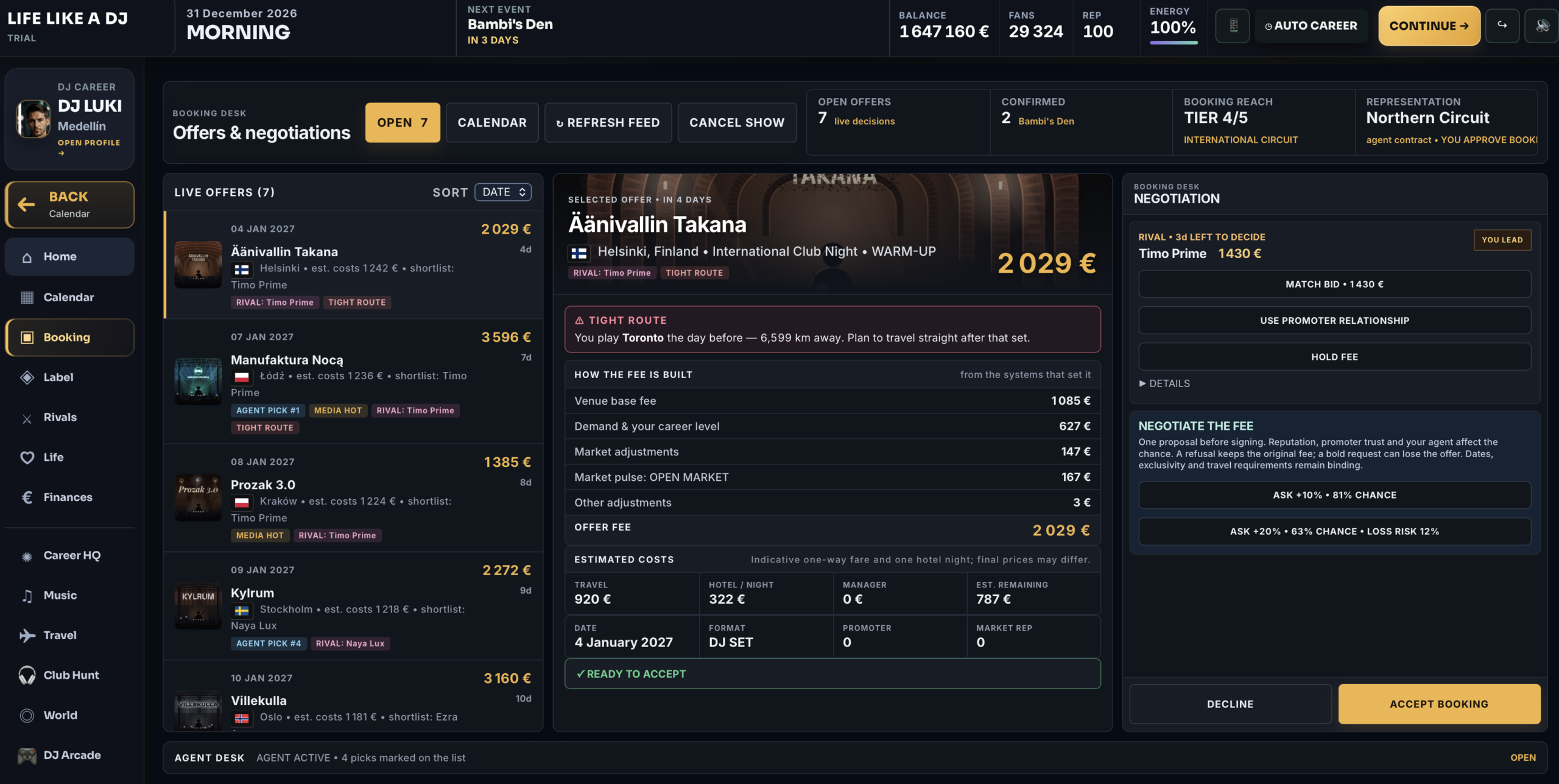
Above all, the uncertainty and the invisible work. When someone watches a DJ on a stage, they rarely see the negotiations, travel, costs, setbacks and relationships behind that moment. I remember spending my own money on a train ticket to a club where I wasn’t even sure I would be allowed to play.
That is why the game isn’t just a succession of exciting shows. It includes the decisions that lead to those shows: whether to accept a low-paid booking, which city to travel to, when to focus on producing music and how to build a reputation in a new market.
I also wanted to show that a career isn’t a straight line. A local residency, a cultural-centre event or a modest summer festival can matter just as much as a bigger gig, sometimes in ways that only become clear later.
How do you make money management, bookings, reputation and relationships compelling decisions rather than administrative chores?
The key is to make the systems affect one another. A booking should not be just a name on a calendar. It should force a choice: Is the fee worth the journey? Will I reach a new audience? What will this do to my energy, finances and ability to work in the studio?
I know those trade-offs from experience. Early in my career I sometimes accepted a financial loss to gain a chance to perform. Later, different kinds of events could pay the bills while pulling me away from the music I most wanted to play.
The most interesting decisions are those without one obvious correct answer. Taking the highest fee may not be the best move for your career. Staying in the studio may cost you income today but create opportunities tomorrow. I don’t want players to do paperwork; I want them to feel the consequences of their ambitions.
You’ve worked as AISHERR for over 20 years. Which experience from your own career surprised you by becoming a good game mechanic?
A small gig can be more valuable than a big one. That lesson stayed with me from my club years. You might play to a relatively small crowd, meet the right organiser or DJ, and find that the connection opens doors months later.
It also made me think about the earliest days when I paid to travel and played without a fee. In a conventional game, that could look like a bad deal. In a career simulation, it can be a perfectly rational investment in experience, relationships and a new audience.
That’s the mechanic I find fascinating: the value of an opportunity isn’t always the number printed on the contract.
One small clarification: I’ve been involved in DJing for more than twenty years; AISHERR is my music-production artist name, not necessarily the name I used at every stage of that journey.
How did you approach the playable live-show sequence, and what role does music play in shaping the player’s choices?
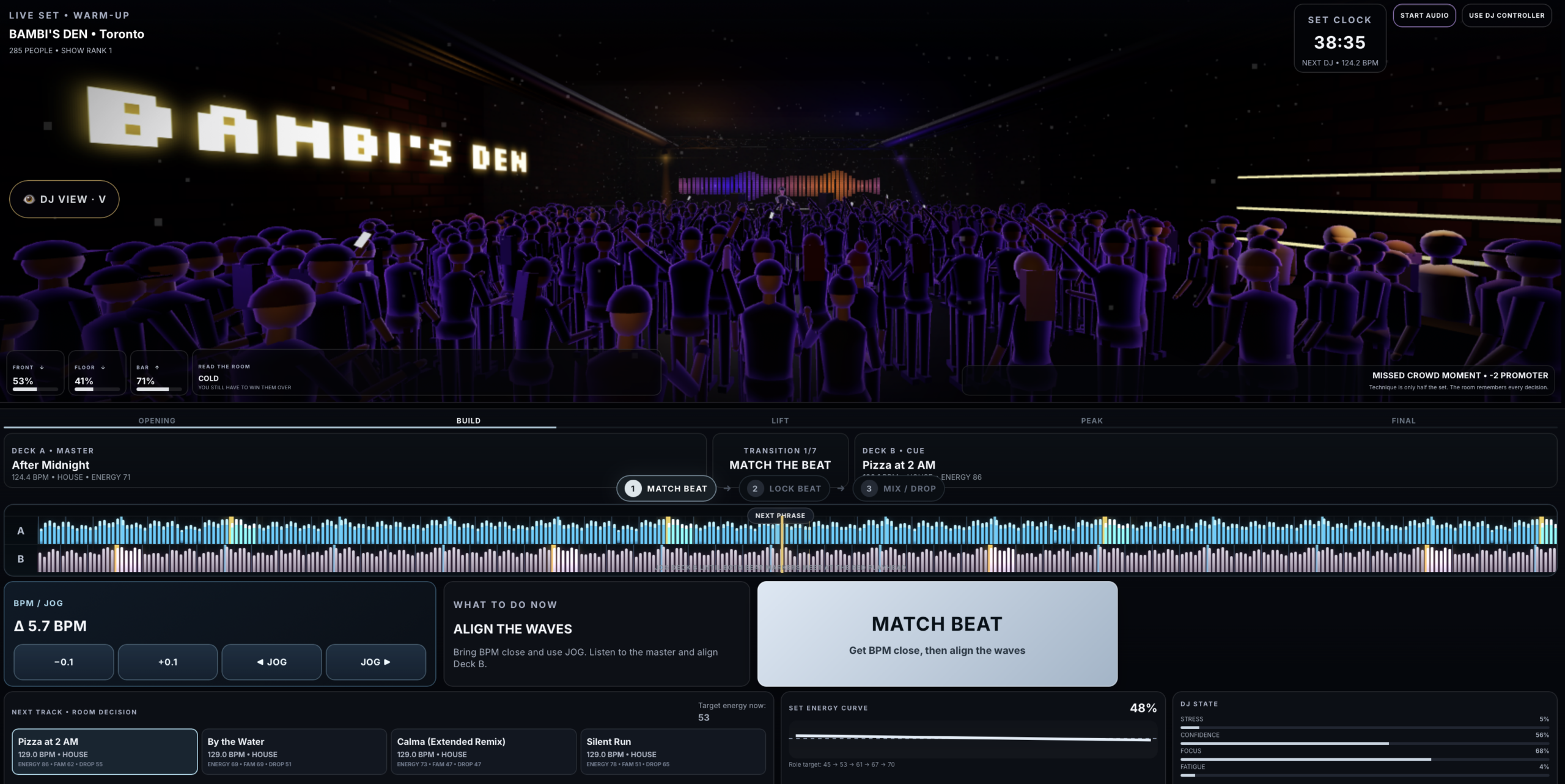
The show is the emotional payoff for everything that happens elsewhere in the game. I wanted it to feel different from the menus and numbers, but not become a separate rhythm game.
The browser build’s SHOW system uses a waveform, crowd, lighting and stage effects to create the atmosphere of a performance. For me, that visual energy matters because I know what it feels like to go from preparing a set to standing in front of people.
At the same time, the show sits within a bigger career. Your bookings, preparation and decisions before and after performing are part of its meaning. Music creates the emotional context, while the simulation asks players to think about the choices surrounding it.
What have players taught you through the current browser build, and which features remain specifically for the proposed PC edition?
Releasing a playable browser build was a way to test the idea with real people rather than develop it in isolation. One important lesson is that players are interested in the life around the music, not just the stage.
Feedback has also shown me how much clarity matters. When bookings, travel, finance, studio work and reputation are connected, the interface must help the player understand those connections instead of becoming another obstacle.
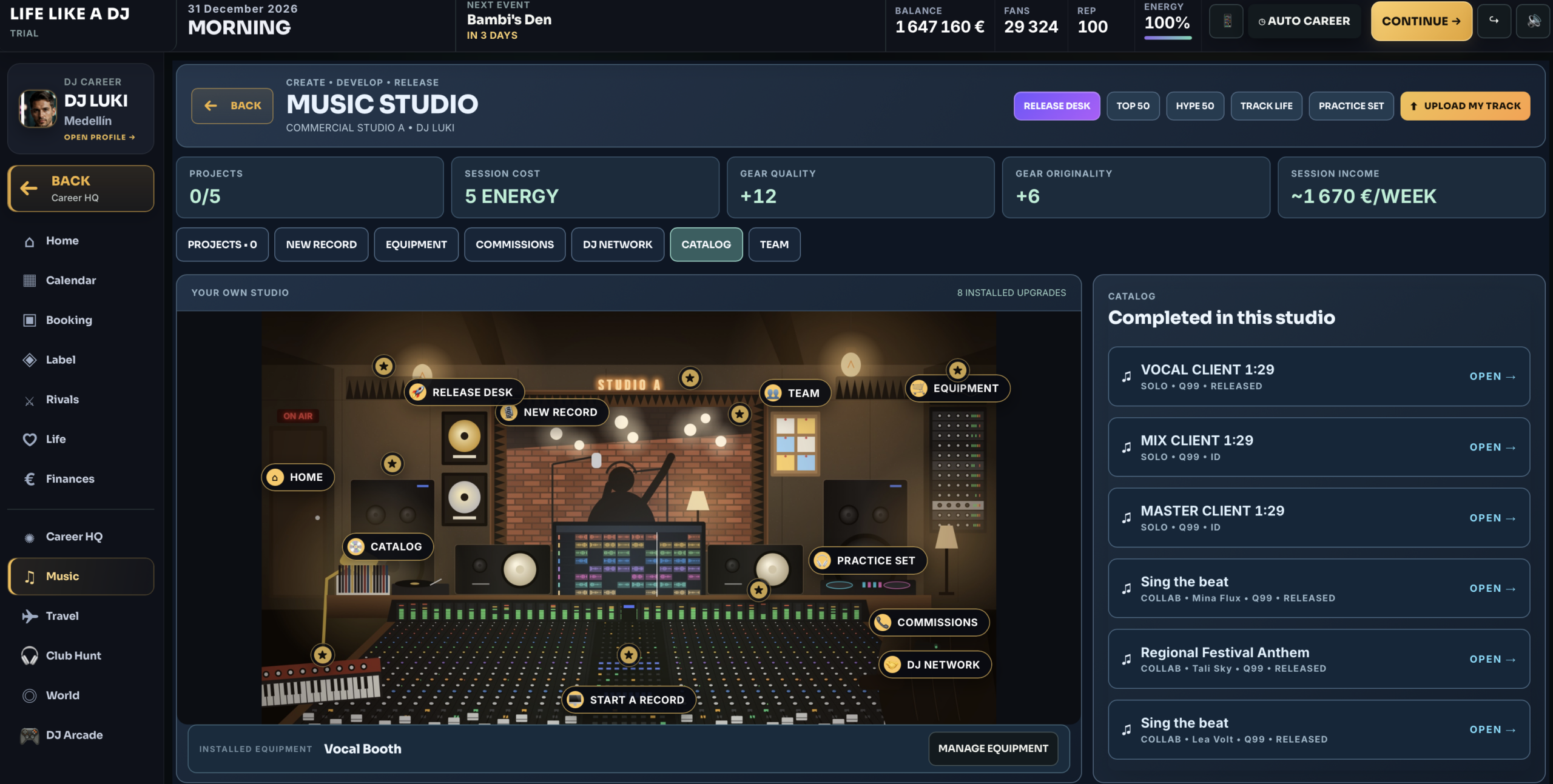
The public browser build is already playable and includes the core career loop, booking and travel systems, studio activities, finances, live shows and wider music-industry interactions. The proposed PC edition is intended to build on that foundation, with further refinement, presentation and systems development. I don’t want to describe unfinished ideas as confirmed PC-exclusive features or promise things that haven’t been implemented. The browser version is the concrete experience people can assess today; the precise scope of the PC release is still being shaped by development and feedback.
What would you most like players to understand about the people behind electronic music after spending time with LIFE LIKE A DJ?
That behind every performance is a person trying to build something. Audiences see the stage lights and the celebration. They don’t always see the years of learning, the money spent, the unsuccessful journeys or the difficult choices.
I still remember travelling across Wielkopolska by train, hoping someone would give me a chance to play a short set. Today, I can create a game in which somebody on the other side of the world might experience a version of that journey. That feels extraordinary to me.
Of course I want LIFE LIKE A DJ to be entertaining. But if players come away with a little more respect for the work, persistence and uncertainty behind an artist’s career, that would mean a great deal.
Not every talented DJ becomes famous, and not every good track finds an audience. A career is not only about fame. It’s also about finding your own path.
Play LIFE LIKE A DJ
Developer: Łukasz Zaranek, independent creator (AISHERR, DJ and music producer). Official website · Play the browser build.