
First Signal | Indie discovery
Medieval strategy games are fond of promising you an army. Pennants of Glory: Condottiere would rather give you the responsibility of keeping one employed. Between the battles, the wages come due, the equipment needs replacing and the people who hired you may discover that loyalty is negotiable.
This is an ambitious single-player medieval strategy RPG from Confus Games, being developed by solo creator Arturas Baranauskas. We’ve been speaking with the developer, who provided access information and an approved folder of original early-alpha screenshots. What follows is an examination of the design and its developing systems, not a scored review or an account of playtime we haven’t completed.
When a battle is bigger than the hero
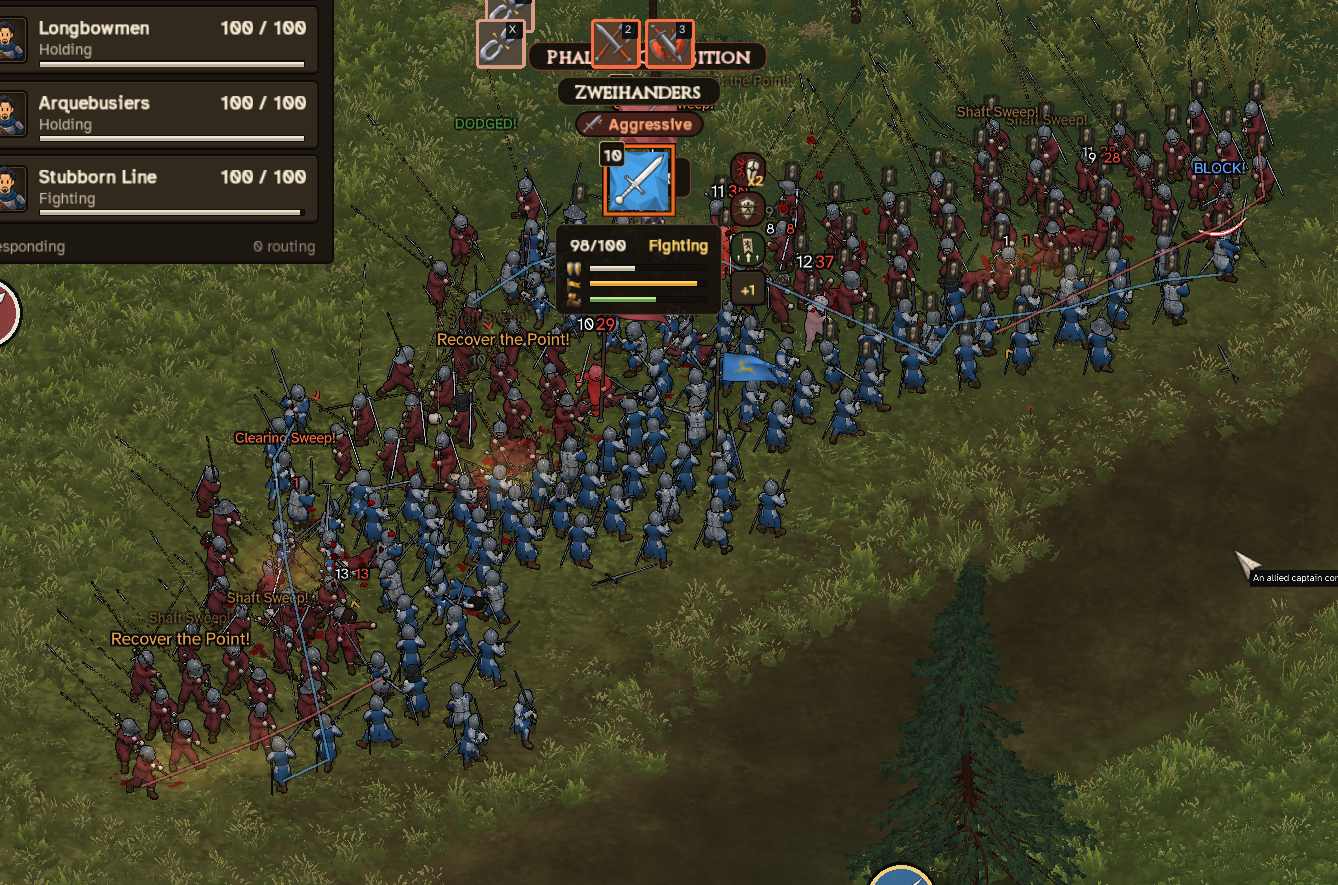
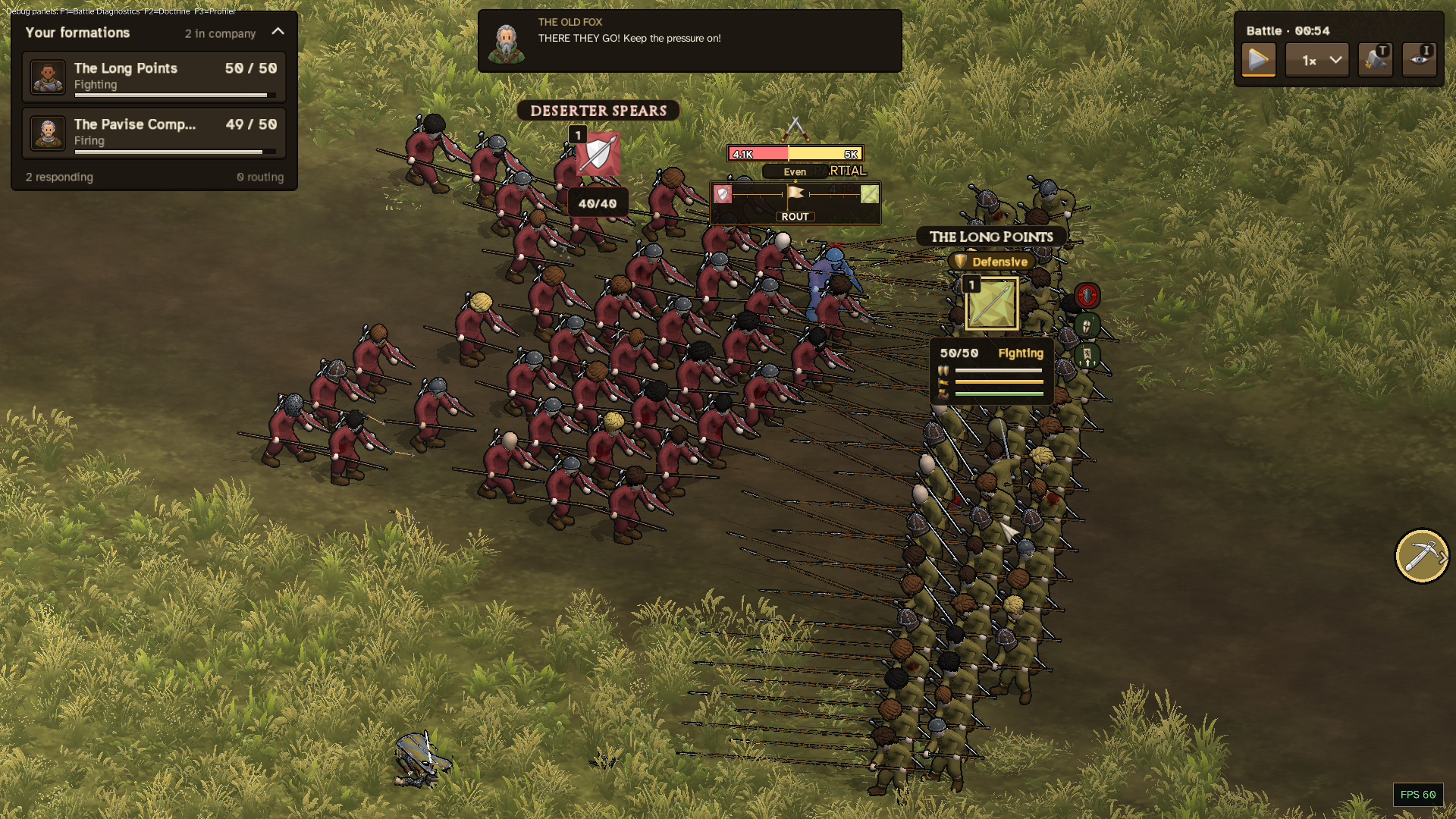
The game’s most immediate attraction is the battlefield itself. Where some mercenary RPGs reduce combat to a handful of fighters, Condottiere promises commands for up to 600 of your own soldiers across large real-time 3D engagements. Individual troops are organised into formations, each with equipment, a captain and a role. A line can brace against a charge, a reserve can support an exposed flank, and one exhausted unit can be withdrawn before its resolve collapses.
The screenshot makes the ambition obvious. Masses of coloured figures press into one another, while formation readouts, directional orders and morale indicators fight for attention at the edges. It isn’t a cinematic tableau pretending to be strategy. It’s a tactical interface trying to tell you which part of a crowded line is about to fail.
Arturas describes a combat system built around holding position, breaking through enemy ranks and knowing when the risk of a push is worthwhile. When a breach opens, the critical decision is whether to exploit it or protect the gap you’ve left behind. The game also offers a tactical pause, allowing players to coordinate orders without requiring frantic real-time clicks.
Every formation has to survive beyond the next fight
A battle doesn’t end when the opposing troops run away. Wounded veterans, broken equipment and depleted supplies follow your company into the next contract. There is an equipment and training layer underneath the fighting, with players recruiting captains, assembling up to eight persistent formations and bringing five into a battle.
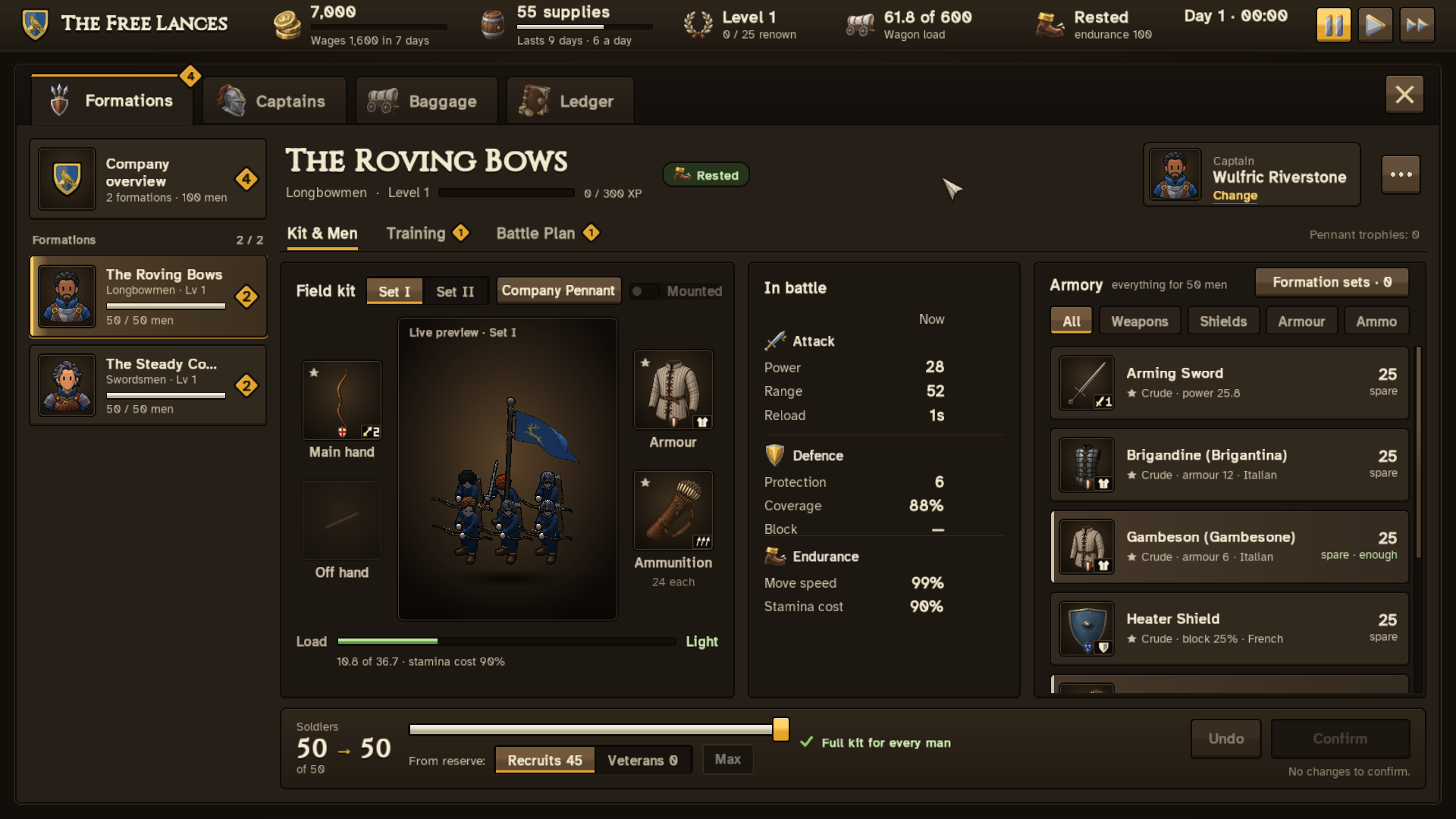
That means losses should have consequences beyond a post-battle statistic. A hard-won victory might still leave you unable to afford replacing good armour or rehiring enough infantry to take the next job. In the management screenshot, even a company at the very beginning of its campaign has a wage bill and a limited stock of supplies. Those are the quiet numbers that can turn the following battle against you.
The kingdom doesn’t wait for your company
Outside the fighting is a procedural campaign with factions competing for territory. Towns produce goods, merchants move along roads and raiders attack the routes that keep settlements supplied. A powerful faction might offer lucrative work, but the political cost of accepting that contract can outlive the battle itself.
This is the point where the project becomes more interesting than a series of tactical maps. The developer’s recent playtest notes describe expanded disputes between noble houses, succession politics, raiding contracts and a more detailed economy in which trade prices respond to scarcity, distance and demand. There’s even work underway on army rations, caravan delivery and siege-camp negotiations. It’s a remarkable list for one developer, and a reminder that ambition is not the same thing as a finished system.
If these layers connect cleanly, they could make contract selection feel properly strategic. A rich employer may be a dangerous enemy tomorrow. A caravan worth protecting might also be carrying supplies your company desperately needs. The best campaigns are usually made from those problems, where there is no obviously correct choice.
A promising alpha, not a finished campaign
The Steam listing still gives no firm release date, and the developer describes the project as early alpha. Playtest builds are being updated, with recent notes covering diplomacy, economies, combat behaviour and stability. Players can currently request Steam Playtest access through the store page, but the final game should not be treated as released.
The early screenshots also show debugging and work-in-progress UI. We are retaining them as genuine development captures rather than smoothing them into false marketing imagery. Their rough edges are evidence of an evolving project, and they set appropriate expectations for anyone considering a playtest.
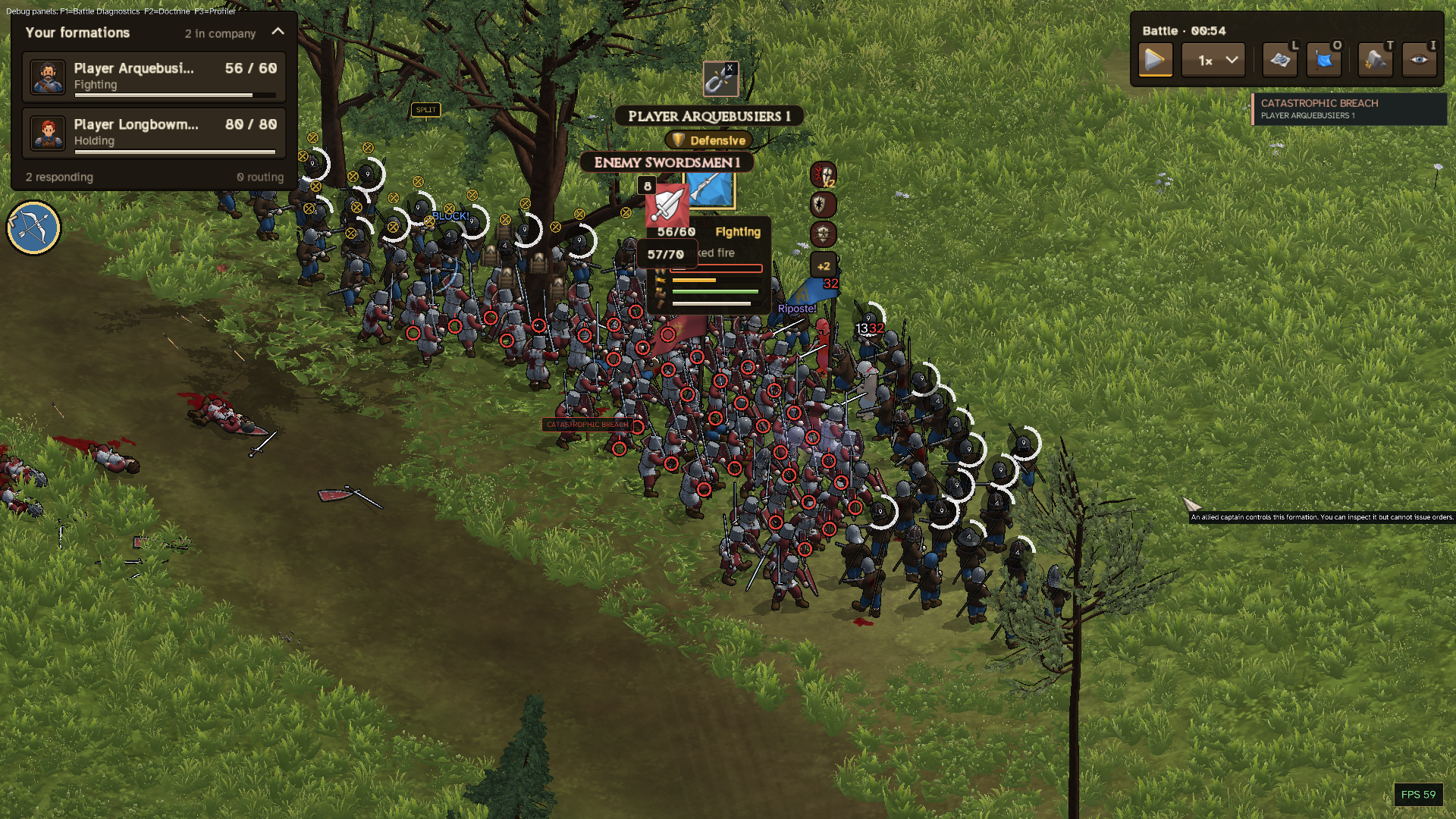
There is one additional disclosure worth making. Confus Games states on Steam that some character voice lines were created using generative AI, with plans for a switch to disable them and a possible future replacement with human performances. That doesn’t mean the gameplay screenshots above are AI-generated art: they are authentic captures supplied by the developer. It does mean the audio content should be described accurately.
There’s an appealing contradiction at the centre of Condottiere. Its battles aim to be huge, but its most personal drama may come from a company ledger. You can command hundreds of soldiers, yet a single bad contract or a ruinous bill might undo everything you’ve built. The real question is whether the living kingdom and the tactical combat will eventually fit together as one convincing campaign.
Follow development: Pennants of Glory: Condottiere on Steam. Developer: Confus Games. Platform: PC. Status: early alpha / Steam Playtest; public release date to be announced.
Editorial note: Original early-alpha screenshots reproduced with permission and credited to Confus Games. We have not redeemed private review access, played a final build, or assigned a review score.