Deep Frost: The Thinking Man’s Among Us
Tense, gritty and genuinely well thought out. Aeon Games Canada’s Antarctic social-deduction game makes you investigate your own assumptions before asking you to live with the consequences of a wrong decision.
Among Us has made a party game out of accusing your friends, watching them protest and voting somebody into the void. Deep Frost takes the same irresistible question, who among us is not who they claim to be?, and asks you to approach it with the patience of an investigator rather than the volume of a meeting room. It is, in the best possible sense, the thinking man’s Among Us.
And after spending time with its cold, suspicious little world, we are impressed. Deep Frost is tense without relying on constant shocks, gritty without gratuitous spectacle, and clearly built around a carefully considered set of systems. It is also, quite simply, very enjoyable.
An Antarctic nightmare built around one question
Developed by Aeon Games Canada and released for Windows on Steam on 27 October 2026, Deep Frost is a single-player social-deduction horror game set aboard a failing Antarctic research station. Twelve researchers are trapped together, and some of the faces you recognise may belong to the Thaw, a parasitic intelligence capable of copying a member of the crew.
You have up to nine days to identify the impostors and survive. Each day gives you work to do: investigate station records, speak with colleagues, inspect evidence, decide what to say in public and eventually cast a vote. Meanwhile, the station’s integrity and survival needs refuse to wait politely for you to finish interrogating everybody.
The premise evokes The Thing, but the important twist is how much weight Deep Frost gives to reasoning. This is not just a question of spotting suspicious behaviour. It is about determining whether the behaviour you noticed means anything at all.
Evidence is not the same as certainty
The most satisfying element of Deep Frost is its insistence that an allegation should be tested. A researcher can offer an account, but is it consistent with the station’s records? Does the source actually support the conclusion you’re drawing? Is somebody repeating an allegation because they have evidence, or because they trust the person who first made it?
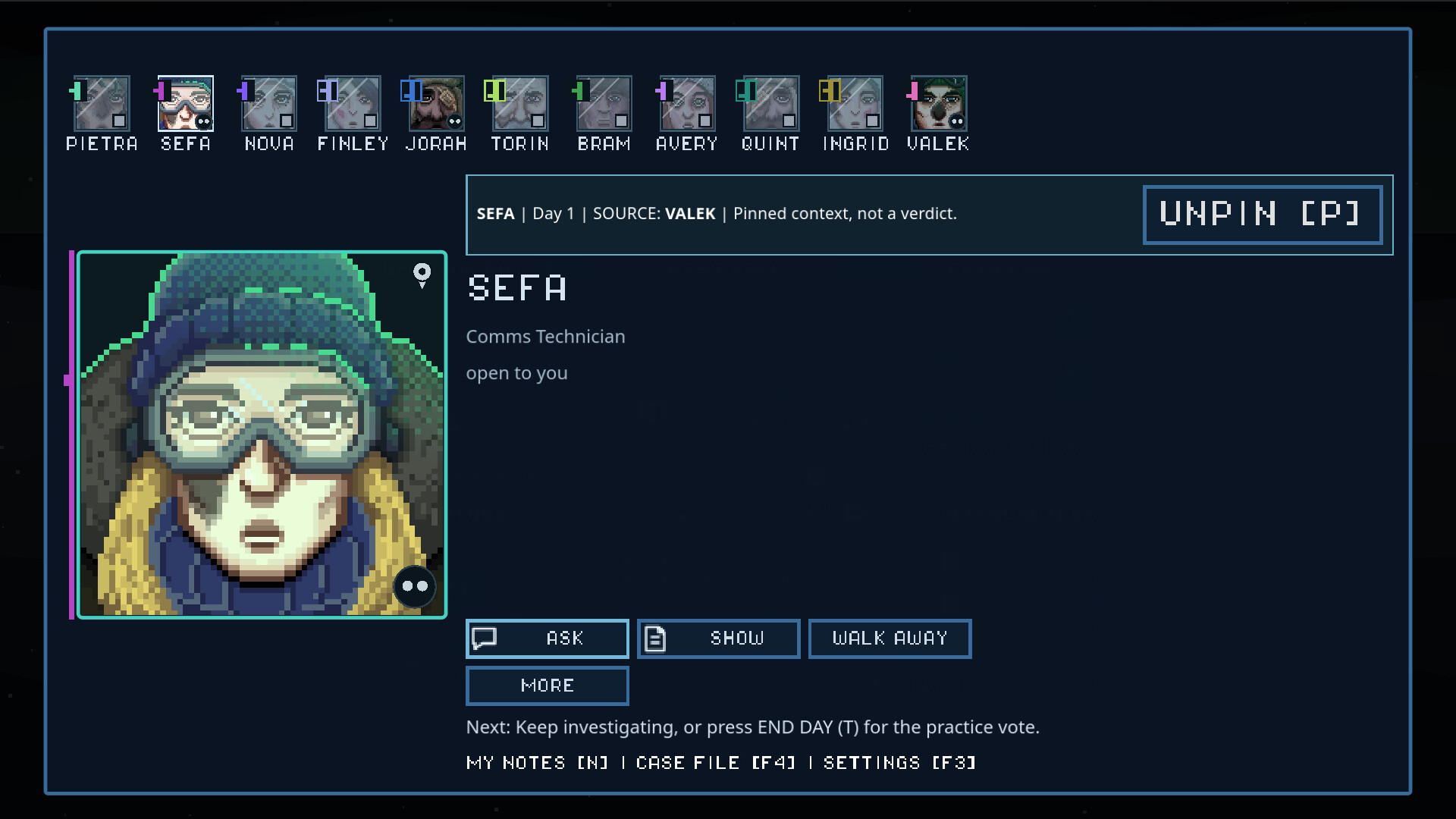
That last distinction is particularly good. The game is built on the uncomfortable difference between knowing what somebody said and knowing whether they are right. The Case File keeps sources, testimony and developments close at hand, encouraging you to return to the details rather than simply pick the character who looks shiftiest.
It makes the act of investigation enjoyable in its own right. Finding a clue is useful. Understanding its limits can be even more valuable. In many deduction games, a piece of evidence is practically a neon arrow pointing to the next answer. Here, the uncertainty feels much more human.
People, not just suspects
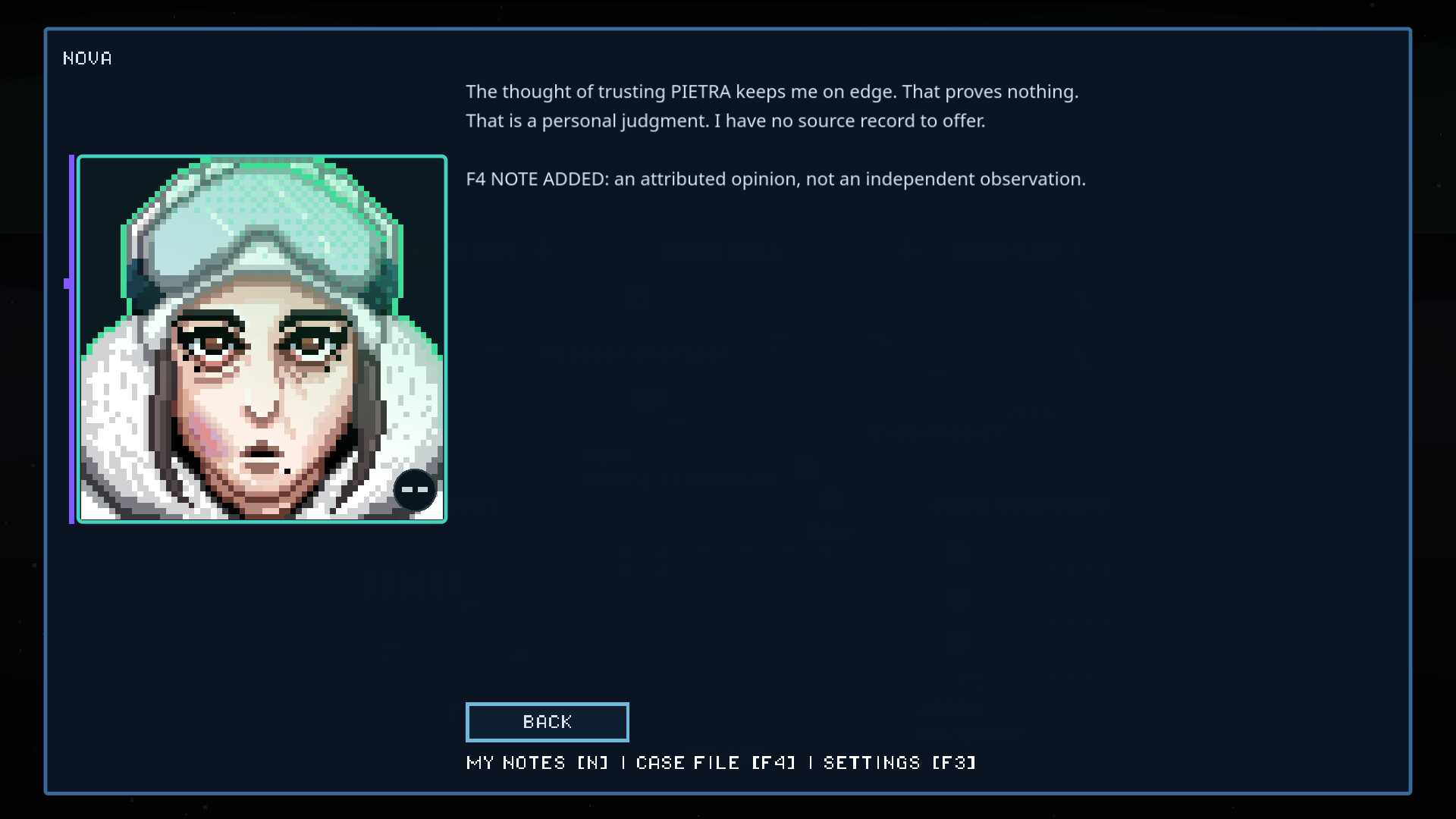
Social deduction lives or dies on its cast. If everybody is merely an accusation waiting to happen, the mystery quickly becomes a set of mechanical switches. Deep Frost has the more interesting idea of treating its researchers as people with opinions, relationships, insecurities and memories.
Conversations can reveal something beyond an obvious clue. An honest admission might make someone a little more comfortable with you. Failing to maintain a relationship can erode that warmth. And a crew member’s trust in one colleague does not necessarily extend to the person you suspect. Those small distinctions are what give the investigation its texture.
There is something unusually effective about sitting with another researcher, discussing fear or doubt, and realising that the next vote might still put them at risk. The close-up pixel-art portraits help these exchanges register as more than simple lines on a spreadsheet.
It is not a substitute for the unpredictability of playing with real people, and it does not need to be. This is social deduction built for a solo player, with the freedom to move deliberately, read carefully and make a decision on your own terms.
Where the tension becomes real
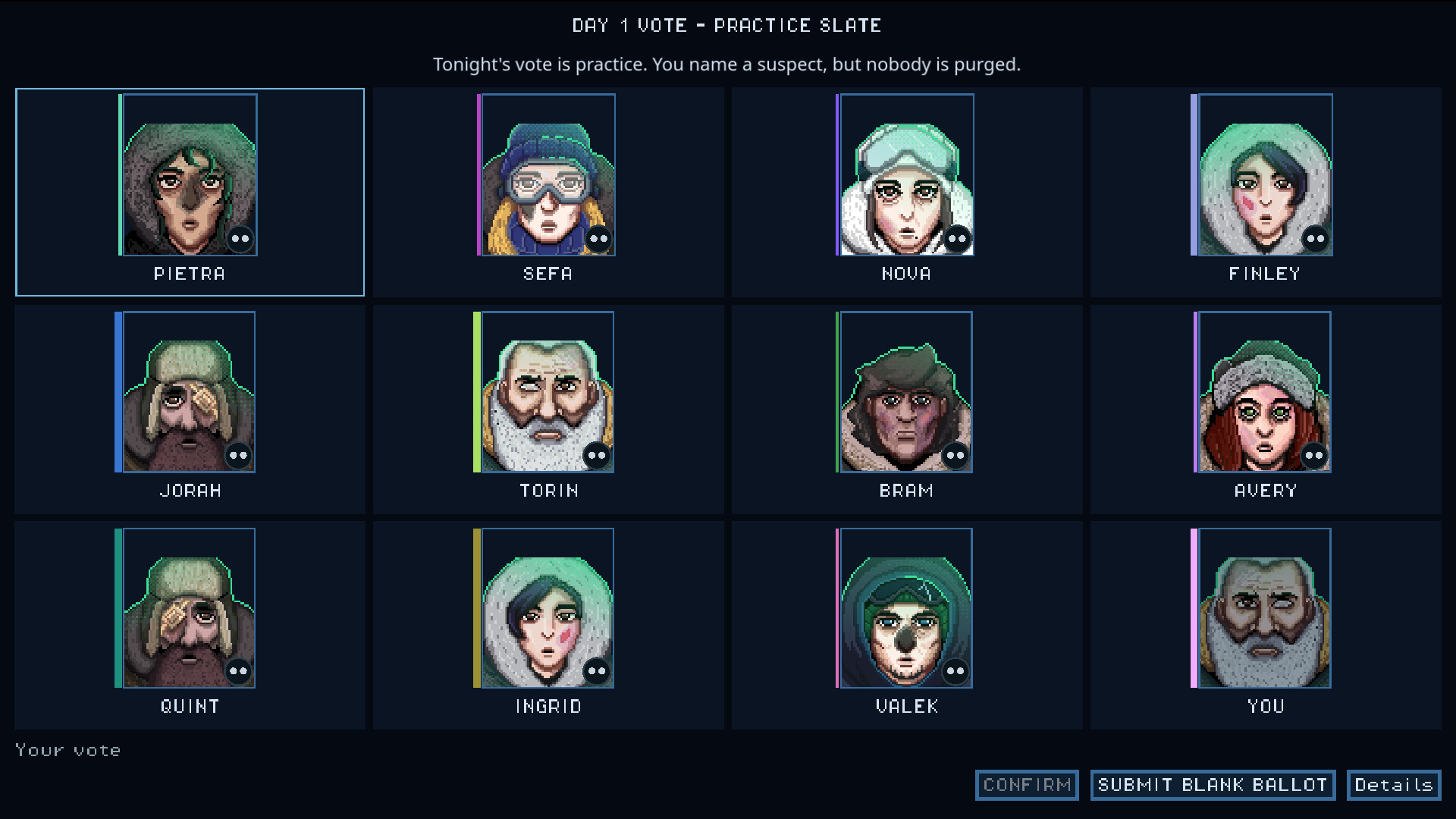
At the Round Table, what you say publicly and what you select on the ballot are separate decisions. You may accuse, defend or stay silent before the votes are cast. The people around you are not guaranteed to share your suspicions, and the captain’s weighted ballot can give the result an additional edge.
These meetings have real bite because a mistake isn’t abstract. In our own time with the game, a purification ended with the devastating confirmation that a human crew member had been killed. We won’t name the character or reveal any of the game’s endings, but that single result tells you a great deal about its tone. This isn’t a light-hearted exercise in ejecting the wrong colour from a spaceship. An incorrect judgement feels grim, and it should.
Crucially, Deep Frost builds towards those decisions. You have looked at records, spoken to people and had the opportunity to develop a theory. When a decision goes wrong, the game makes you question the reasoning that brought you there. That is far more interesting than an arbitrary surprise.
A station that will not wait for your investigation
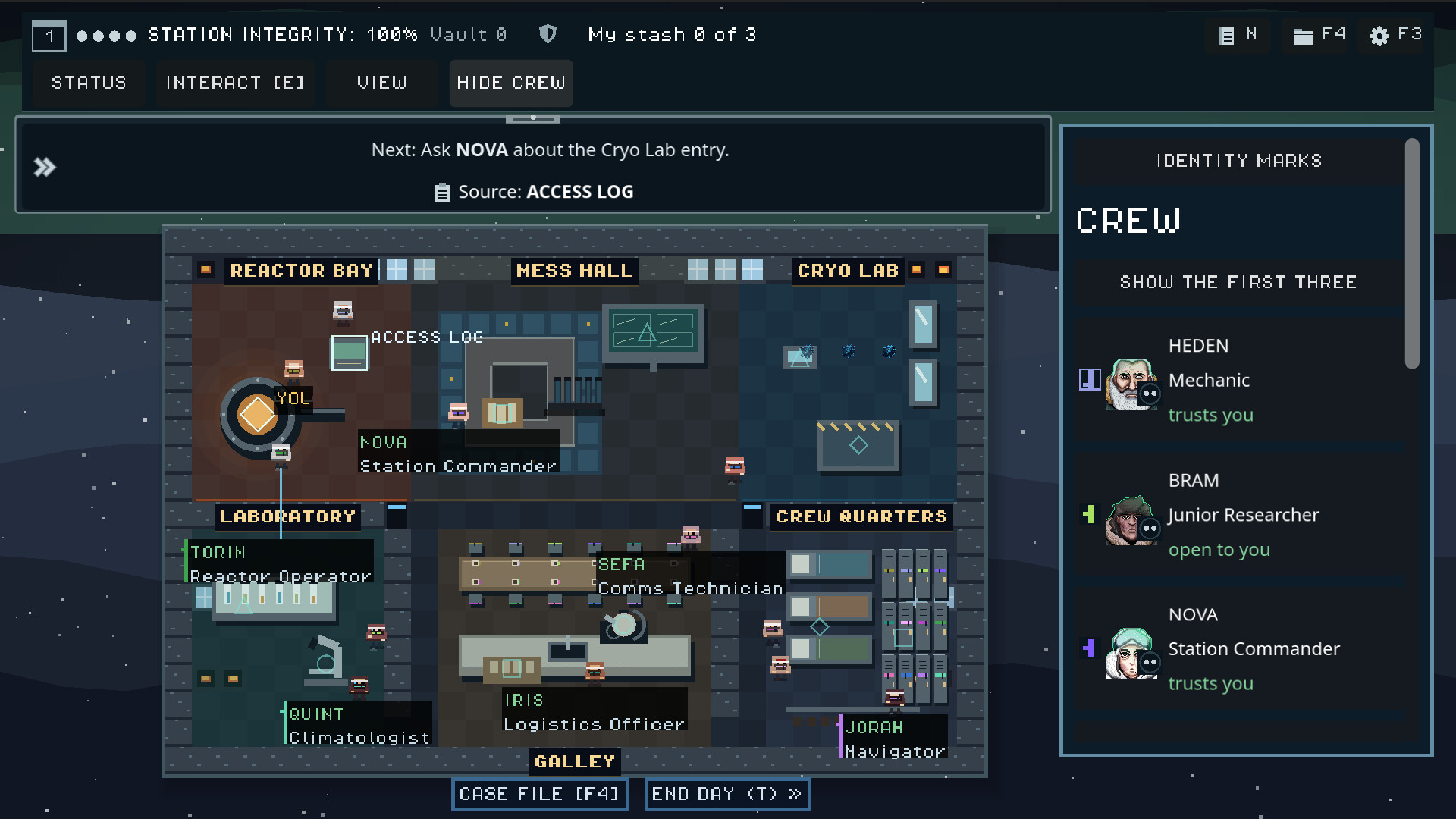
The survival layer gives the game another useful source of pressure. Station integrity, operational problems and limited resources matter alongside your theories about the crew. Even while you are chasing a lead, the outpost needs to keep functioning.
That is a clever way to keep the setting relevant. It would have been easy to use the Antarctic station as atmosphere alone, but here the environment helps shape your decisions. Time spent investigating has a cost; keeping everybody alive demands attention of its own. The people you suspect may also be the people you need to work with.
The result is a deliberate, sometimes uncomfortable rhythm. Gather evidence. Talk to someone. Repair what you can. Think again. Then choose. The tension is sustained by the structure, not by throwing a jump scare at you every few minutes.
Gritty, distinctive, and occasionally demanding
Visually, Deep Frost has an appealingly austere identity. Cold blues, dark interfaces, tightly framed character portraits and detailed pixel art give the station a convincing sense of isolation. It does not chase photorealism, but its look complements the bleakness of its subject. Some of its strongest moments come from simple portraits and dialogue rather than lavish visual effects.
There are compromises. The amount of information the game asks you to manage can make the interface feel dense. Long lists of possible accusations, evidence screens, character relationships and individual records require attention, and scrolling through choices can interrupt the flow when you are already deep in a theory. The presentation is functional and distinctive, but not always effortless to navigate.
That deliberate pacing is also part of the deal. Anyone looking for fast action or a constant succession of dramatic reveals may find the emphasis on reading, comparing and reasoning a little dry. For players who enjoy methodical mysteries, however, that same quality is one of its strengths.
We would rather have a game this confident in its ideas than one that buries them under noise. A little more streamlining would help, but the underlying design is strong enough to make the occasional interface friction feel worth pushing through.
Final verdict
Deep Frost is a tense, gritty and impressively thoughtful take on social deduction. By taking the familiar appeal of Among Us and building a solo investigation around evidence, relationships and the cost of mistaken trust, Aeon Games Canada has created something genuinely distinctive.
The information-heavy interface and unhurried pace will not suit everyone, but the atmosphere, intelligent mechanics and weight of its decisions make this a very enjoyable experience. If you love unpicking a mystery and questioning your own conclusions, this deserves your attention.
- What works
- Smart evidence-based deduction, tense voting, meaningful relationships, atmospheric pixel art and decisions with consequences.
- What holds it back
- Information-dense screens, long choice lists and a deliberately measured pace that takes some adjustment.
Deep Frost | Game details
Developer and publisher: Aeon Games Canada · Platform tested: Windows PC · Release: 27 October 2026
View Deep Frost on Steam · Try the free demo
Read our interview with creator Ugur Ozer · Read the original First Signal feature
Editorial disclosure: Coloured Static Press received a complimentary full-game Steam review copy directly from Aeon Games Canada. This 81/100 score and all opinions are the outlet’s independent hands-on assessment. The developer also provided two separate retail giveaway keys; those prizes have no bearing on this review. Images are official gameplay screenshots credited to Aeon Games Canada. No ending spoilers are included.