
INDIE DEVELOPER INTERVIEW | More than three decades after creating a Zeppelin game for MS-DOS and the Commodore Amiga, the developer behind The Last Zeppelin has returned to game development. We spoke with Innopede about rediscovering airships, an alternative 1928 ruled by reptiles, and the joy of making games again.
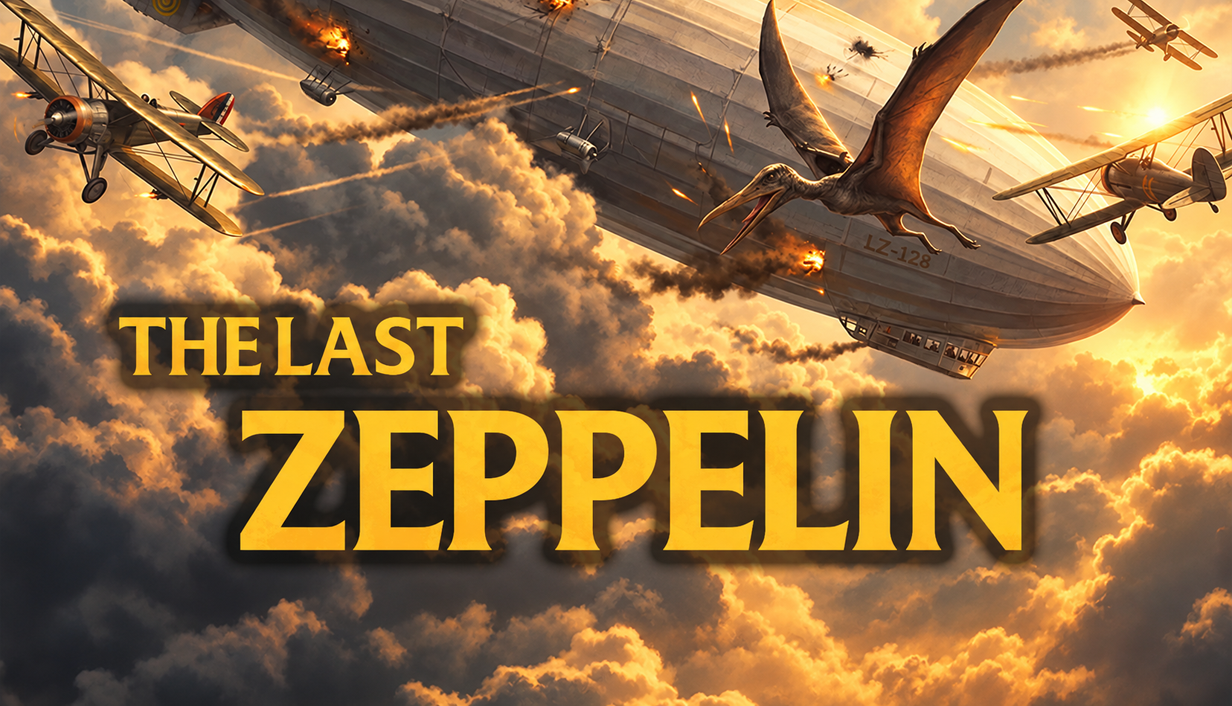
What began as an experiment with First World War battleships became a return to a fascination first explored in 1994. In this exclusive Coloured Static Press interview, the developer discusses the unusual setting, design decisions, technical challenges and the importance of making games for the joy of it.
1. What originally inspired The Last Zeppelin?
Innopede: I first had the idea of developing a game with First World War dreadnought battleships and started some tests with movement. Then suddenly the idea came: why not do this with Zeppelins? I really liked the movement of the Zeppelin on screen.
I’ve always been a big fan of these giant, majestic airships. I developed the MS-DOS and Commodore Amiga game Zeppelin: Giants of the Sky in 1994 for Ikarion, published in the US by MicroProse. So I thought I’d do something with Zeppelins again.
2. How would you describe the world and its underlying story?
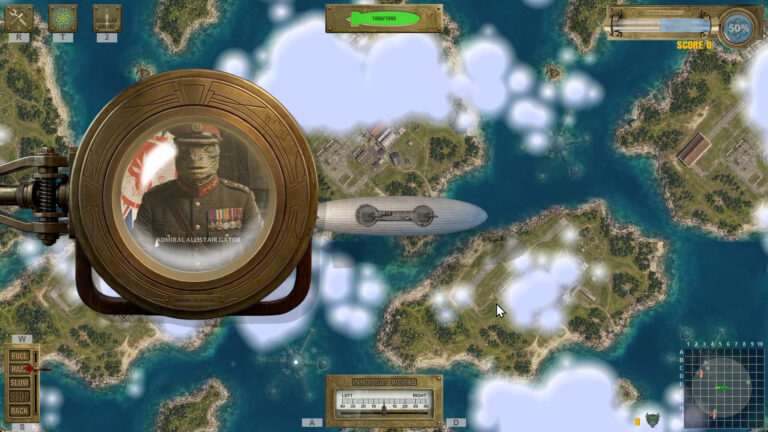
Innopede: The year is 1928, but not the one you know. The crew of the LZ-128, a top-secret German Zeppelin, had a malfunction in their experimental zero-drive engine and became trapped in a parallel dimension where a reptile master race took power during the First World War and enslaved humanity.
The reptiles wanted to use the rift between dimensions to conquer our timeline, but the crew sealed it by detonating a zero-point charge. Now they are trapped in a hostile universe. You are the last Zeppelin.
The reptiles use First World War-style biplanes, fighters and uniforms, alongside flying pterosaurs, jet fighters, war Zeppelins and flying saucers acquired from other parallel dimensions. The prequel story is available as a free audiobook on YouTube and briefly in the game.
3. What makes controlling the Zeppelin different from flying a conventional aircraft?
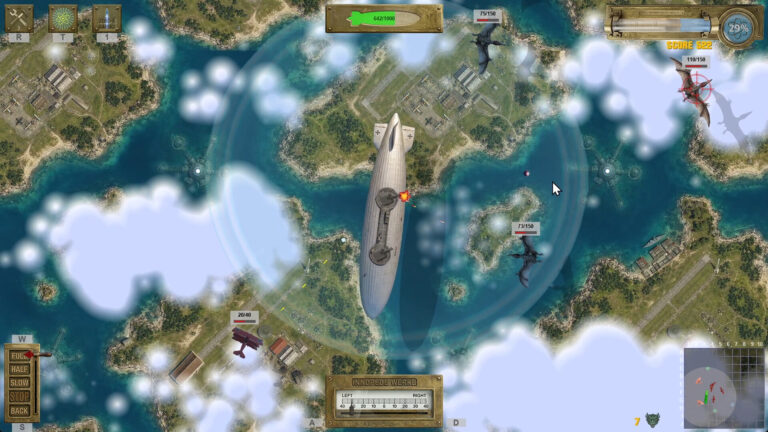
Innopede: Because the Zeppelin is so enormous, it reacts more slowly and sluggishly to steering and acceleration. That makes flying it feel different from other top-down shooters. I think we managed to capture that ‘Zeppelin feel’ quite well. The same goes for the big gun turrets.
The reptilian war Zeppelins move differently, with blue thrusters, a little like the new Tesla Roadster.
4. How important is tactical decision-making and managing resources during combat?
In the response provided, Innopede refers to managing encounters with enemy ships and collecting special zero-energy capsules drifting in the sky, as well as finding energy capsules during bonus missions in a reptilian fortress-tower. Part of the original answer was cut off, so this is a summary rather than a complete quotation.
5. How did you create enemies that feel different to fight?
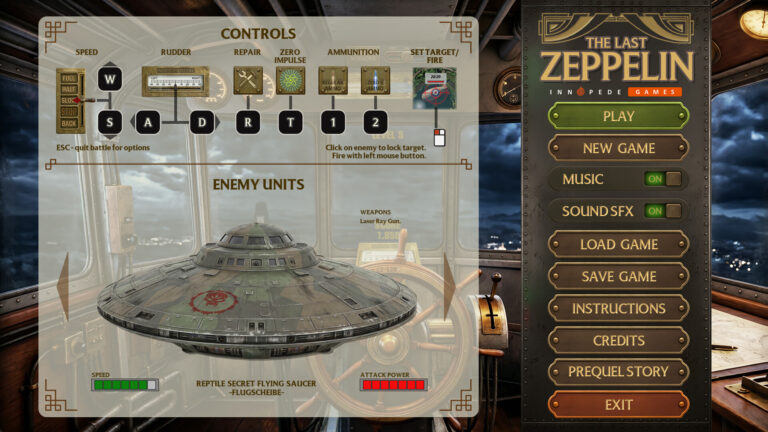
Innopede: I experimented with different planes, how they look, and different strengths and weapons. For example, there are two kinds of flying pterosaurs: one with a machine gun on top, and another with flying mines. The flying saucer uses a laser, of course.
6. How did you settle on the game’s visual direction?
Innopede describes aiming for warm artwork and music inspired by the 1920s and 1930s, combined with a classic arcade look and a casual, approachable experience. The developer also mentions an Easter egg inspired by the eight-bit game Rescue on Fractalus!, where an alien bangs on a spaceship window. Part of the original response was cut off, so these details are paraphrased.
7. How important is the wider narrative?
Innopede points to the free audio prequel and narrative elements encountered during bonus missions inside the reptilian fortress. The developer suggests that the crew’s chances of returning to their original timeline remain bleak as enemies grow stronger with each level. Part of the original answer was cut off, so this is a summary.
8. What has been the biggest technical challenge?
Innopede: It’s always a challenge to make a game playable for everyone, so it isn’t too difficult at the beginning or too easy. Finding the right balance while still reflecting the casual-game aspect was difficult. So was making the game look retro without going completely pixel art. I also experimented a lot with enemy movements and reactions.
9. What turned out to be surprisingly difficult?
Innopede: In the bonus missions there are ten rooms with secrets behind each door: keys, gold, a lock, a reptile on a toilet, and more. There was a bug when distributing these items. I searched for days and it turned out to be a copy-and-paste error.
I also had an idea for a giant Tyrannosaurus rex walking on the ground that you would need to fight. I made some animations, but because the Zeppelin is higher in the air, it didn’t really make sense, so I dropped it.
10. What has been your proudest moment?
Innopede: Seeing people have fun playing it, our testers, and the feeling you get when playing with the retro atmosphere created by the graphics and movement. Especially that I have so much fun playing it myself.
11. Has player feedback influenced the game?
Innopede: I received feedback from testers about the difficulty level and adjusted it. I can’t remember when I came up with the idea of the bonus mission in the castle. I made a few sketches and sent them to friends and testers, asking whether they’d include the idea. The answer was really clear: yes, it needs to be there. So I added it.
12. What’s next for The Last Zeppelin?
Innopede: We’ve released the first demo, with only the first three levels. The final release is planned for November or December this year, with additional enemies including pterosaurs, war Zeppelins and flying saucers, plus a special reptilian fortress. Each level will get harder with more and stronger enemies.
The final release will also include Steam leaderboards for levels and scores, and Steam achievements. The game is intended to be a casual title offering quick, entertaining fun, something you can jump into again and again like an arcade game, without a significant learning curve.
13. What advice would you give another independent developer?
Innopede: Just do it. Make the games you want to play and have fun. And it is never too late to start. I took a break of over 30 years and then started again with game development last year.
From 1994 to now
That final answer captures the story behind The Last Zeppelin. More than thirty years after working on Zeppelin: Giants of the Sky, its creator has returned to a familiar fascination, this time with a strange parallel universe and an arcade spirit. It’s a reminder that independent development can be as much about rediscovering what you love as inventing something entirely new.
Further reading: Read our original The Last Zeppelin spotlight and listen to the official prequel audiobook.
Interview responses lightly edited for spelling, punctuation and readability. Answers 4, 6 and 7 are identified as summaries because the supplied text was incomplete. Screenshots and artwork courtesy of Innopede. This is a developer interview, not a hands-on review.