
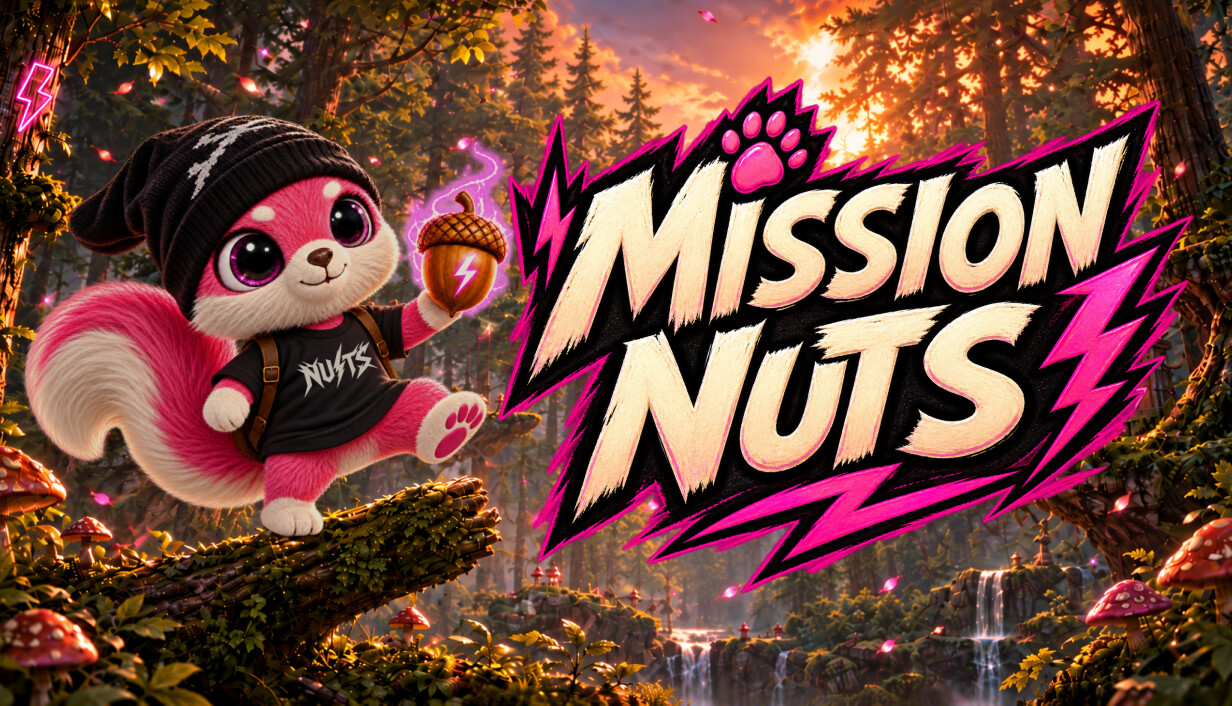
Mission Nuts: A Little Pink Squirrel, and the Light Behind the Adventure
Almost thirty years in graphic design gave Tom Sheol a remarkable eye for colour and composition. Making a game alone, however, has asked something entirely different of him. In this conversation, he tells us how a squirrel named Wiewiu became a deeply personal 2D platform adventure about friendship, loss and hope.
At first glance, Mission Nuts is a bright, energetic platformer about a pink squirrel with a habit of finding trouble. Look a little closer and there are layers of meaning tucked between the jumps: a secret room where every clock stops, songs about time and loss, and a friend who brings light to an otherwise dark forest.
Wiewiu was imagined years before the game’s development began in spring 2026. Her creator, Tom Sheol, now spends the spare hours around a full-time job learning Godot, building levels and trying to turn a long-held idea into something players can actually experience. We spoke to him about where Wiewiu came from, the cost of making a level-by-level adventure alone, and why some of its smallest discoveries mean the most.
“To me, Wiewiu is a Little Light.”Tom Sheol, developer of Mission Nuts
Why did you decide to start developing Mission Nuts in spring 2026?
Wiewiu actually came into existence many years ago. My partner and I came up with her during a rather difficult period in my life. We imagined this cheerful little troublemaker, a kind-hearted little spirit in the form of a pink squirrel.
I've always loved squirrels, by the way… I find them fascinating animals — clever, resourceful, intelligent, and ridiculously cute at the same time 🙂
The idea of making a game about Wiewiu had also been with me for years. The problem was that the project I had in mind was simply too ambitious for one person. I didn't have enough time, and I certainly didn't have a team to help me bring it to life.
When more advanced AI tools started appearing, making some of the most time-consuming parts of production much faster, I began to think that perhaps I could finally give it a try.
So, in spring 2026, I decided to turn this old idea into an actual game.
I knew it would be difficult. I just didn't realise quite how difficult…
How did the game's story about friendship, its characters and its world first take shape?
The world of Mission Nuts comes largely from my own experiences, observations and thoughts about life.
The main story is actually quite simple. It's about a little squirrel who goes on adventures, meets friends, gets herself into trouble and somehow manages to get through it all. I wasn't trying to create a complicated RPG with an elaborate plot. Mission Nuts is, first and foremost, a platformer.
But there are several layers to this world.
On the surface, it's a colourful, humorous adventure with funny characters and a slightly crazy squirrel who has her own personality, her own language and her own peculiar expressions.
Underneath all that, though, there are more serious themes. Time, the passing of life, loneliness, darkness and hope appear throughout the game. There are also reflections on modern society, alienation, losing people we love, and the fact that sometimes, no matter how hard we fight, we still lose.
Some of these thoughts are hidden in the lyrics I've written for the songs. Others appear in secret locations, visual details or optional books that tell you more about the characters.
There's also a strong sense of nostalgia for childhood and those carefree days we can never quite get back. I believe that, no matter how old we become, somewhere deep inside we're still children. Sometimes we'd love to be like Wiewiu — spontaneous, curious, a little crazy, and able to find happiness in the simplest things.
Wiewiu herself has a special symbolic meaning to me. She's a Little Light, something that can brighten even the deepest darkness when everything seems lost. The kind of character we might all wish we could meet during the hardest moments of our lives.
Friendship is a natural part of that story. In the first chapter, Wiewiu gets help from her old friend Faree. In the second, she rescues a little bird called Nashe, who later helps her when she's in trouble. And in the third chapter, it's Faree who needs rescuing.
I don't want to explain every symbol or hidden meaning to the player, though. I'd much rather leave people free to discover things and interpret them in their own way.
Which of your graphic-design skills transferred naturally, and what did you need to learn from scratch?
I honestly don't think I could have made Mission Nuts without my background in graphic design.
I've been working as a graphic designer for almost thirty years. During that time, I've learned far more than how to use different software. I've developed a good understanding of composition, colour, visual design and preparing artwork for different purposes.
That experience gives me a huge advantage when creating and editing the game's graphics. I usually know exactly what I want something to look like, how to prepare it and what needs changing to get the result I'm after.
So I didn't really have to learn the artistic side of things from scratch. The biggest new challenge was Godot, the engine I'm using to develop Mission Nuts, and learning how to turn my ideas into an actual working game.
That's a completely different world from creating static graphics. In a game, things can't just look good. They have to move, respond to the player and work properly alongside dozens of other systems.
And believe me, that's where things can get complicated.
How do you balance exploration, secrets, enemies, humour and the platforming challenge?
First of all, choosing a 2D platformer wasn't an accident.
I grew up playing games like Superfrog and Giana Sisters. They're a big part of my childhood, and I still absolutely love Rayman.
I've always had a soft spot for this kind of game, so making a 2D platformer felt like the most natural way to tell Wiewiu's story.
But I should mention that being 2D doesn't necessarily make a game easier to develop. I'm reminded of that regularly, especially when I'm working on more complicated mechanics. Something that looks incredibly simple on screen can take hours and hours of coding, testing and fixing.
As for balancing all these elements, I try to do it through a combination of level design and storytelling on different levels.
At first glance, Mission Nuts is a colourful 2D platformer. Wiewiu is a slightly nutty squirrel with her own strange expressions, her own little language and a very particular personality. You run, jump, fight enemies, explore levels and discover secret places.
Those secrets are part of the exploration. They encourage players to look around and make the gameplay more interesting, but they can also introduce another layer to the game, sometimes a very personal or symbolic one.
Let me give you an example.
In one of the levels, there's a secret room. Before you even find it, you can hear clocks ticking somewhere nearby. That sound is a little hint that there might be something worth investigating.
When you eventually discover the room, you find yourself surrounded by clocks, with an old gramophone standing among them.
You can simply look around and leave. But if you decide to turn on the gramophone, something unusual happens.
All the clocks stop. Even the game's own timer freezes.
Then an old-fashioned jazz song starts playing, with lyrics I wrote myself. The words also appear on the screen as the music plays.
From a gameplay perspective, it's just a secret room with an interesting interaction. But for someone who pays attention to the lyrics, the stopped clocks and the surroundings, it might mean something much more.
That's the kind of thing I enjoy creating. You don't need to analyse the symbolism to have fun with Mission Nuts. But if you're curious, there's another layer waiting to be discovered.
What's evolved since the first two levels shown in the public Steam demo?
Quite a lot, actually. Mission Nuts is still very much in development.
The public demo is really just an introduction to the basic gameplay. It includes the first two smallest levels of Chapter 1 and gives players a chance to get to know Wiewiu, the controls, combat and exploration.
The full game will be much more varied. Each new level introduces a different environment, atmosphere and gameplay elements.
Right now, most of my attention is on Chapter 2. It's a night-time adventure through dark forests, swamps and snowy landscapes. This is also where a new character appears — Nashe, a little bird who can help Wiewiu on her journey.
At the moment, I'm working on the bear boss fight, which is one of the more complicated parts of the game so far.
Development isn't always a straight line, though. Sometimes I have to go back to earlier levels to fix or improve something. Other times, an idea suddenly comes to me for a part of the game I won't even be working on for several months.
It's a bit like putting together a huge jigsaw puzzle. I can already see the complete picture in my head, but I still have to figure out how to make all those pieces fit together and actually work.
What's been the biggest challenge of being responsible for every part of development and promotion?
Without a doubt, the sheer scale of the project.
The game I had imagined turned out to be simply too big for one person, even with my experience and the help of modern tools.
On one hand, I really want to bring my original vision to life. On the other, I constantly have to remind myself of my limitations. Some ideas have to be simplified, and others have to be dropped completely. Otherwise, I could easily spend another several years working on this game.
I also knew from the beginning that I didn't want to make a roguelite. I wanted Mission Nuts to be a compact, fast-moving adventure, more of a journey through different places than a game built around grinding and repeating the same activities over and over.
Unfortunately, that decision comes at a price…
Every new level needs a huge amount of its own content — backgrounds, artwork, animations, enemies, mechanics and interactions. I can't simply keep reusing the same set of elements to fill another few hours of gameplay.
For a solo developer, that approach is absolutely brutal in terms of workload.
Sometimes I think I've chosen one of the hardest possible ways to make a relatively small indie game. But it's the kind of adventure I wanted to create.
Working on Mission Nuts has been much harder than I originally expected. I still have a full-time job, and I spend practically every spare moment working on the game. There have been times when I've genuinely felt that the whole project was simply too much for me.
It's an enormous amount of work, sometimes more than I feel capable of handling. But it also gives me a great deal of satisfaction, especially when something finally works exactly as I imagined after hours of struggling with it.
Marketing is another challenge altogether.
As an independent developer without a big marketing budget, I have to find ways of reaching players myself. In my experience, Steam provides very little organic traffic to a small game like mine, so simply putting up a store page and releasing a demo isn't enough.
I'm hoping Steam Next Fest will help, but that needs careful planning too, as a game can only participate once.
I've also been reaching out to gaming websites and content creators. It's incredibly time-consuming, and most of the time you have no idea whether anyone has even read your email.
Occasionally, though, something nice happens.
For example, a Belgian gaming website called Gamebrain published an article about Mission Nuts and its demo:
https://www.gamebrain.be/mission-nuts-demo-steam/
I didn't even know they were preparing it. I found the article completely by accident while looking through search results.
Little things like that really help keep me going. They remind me that somewhere out there, people might actually be interested in what I'm making.
Because ultimately, you don't make a game just for yourself. You make it because you want other people to play it.
Ahead of the planned release, what do you most hope players take from the game and your development journey?
First and foremost, I hope they have fun.
I hope they grow fond of Wiewiu, smile at her silly antics, enjoy exploring the levels and discovering secrets, and simply have a good time playing the game.
But it would mean something very special to me if Mission Nuts could also move someone emotionally. Perhaps bring back a childhood memory, remind them of happier times, or offer a little comfort when life isn't being particularly kind.
To me, Wiewiu is a Little Light.
One of the songs I've written is about light rising to meet the darkness. Wiewiu is that little light in the darkness. A small, pink squirrel who's a bit crazy, carefree and full of life. The kind of character we'd all love to meet when everything around us seems hopeless.
This idea also appears in the gameplay itself.
In Chapter 2, Wiewiu ventures into a forest swallowed by darkness. She wears a little headlamp that lights up the world around her.
But there's something else. Instead of collecting nuts, her task is to light up unusual flowers that act like tiny lanterns. Each one brings another little point of light into the dark forest.
On the surface, it's simply a change to the gameplay objective. But there's a symbolic meaning to it as well. Wiewiu doesn't just carry her own light — she brings light to the world around her.
And it's no coincidence that, during this same journey, she discovers Nashe, a little bird lying in the snow, frozen and barely alive. Wiewiu saves her with magical berries, giving her a chance to recover.
The Little Light becomes someone's hope when everything seems lost.
I would love it if Wiewiu could bring even a little of that light into someone's real life. Perhaps brighten a difficult moment, or remind someone that hope can still exist, even in the darkest times.
Of course, I don't expect everyone to see the same meanings in Mission Nuts that I do. I don't want to tell players what they should feel or how they should interpret the story.
If someone simply spends a few enjoyable hours with Wiewiu, I'll be happy.
But if, for even one person, this little pink squirrel becomes something more than just a platform game character, that would mean the world to me.
Discover Mission Nuts
The free public Steam demo contains the first two levels of Chapter 1. The full game remains in development, with a Q4 2027 release currently planned. This interview reflects the developer’s work and plans at the time of our conversation, not a hands-on review.
Visit the official Steam page, try the demo and wishlist Mission Nuts ↗
Official game artwork © Tom Sheol. Featured image sourced from the game’s official Steam materials. Developer responses have been lightly edited for spelling and readability without changing their meaning.