
How do you keep a bullet-hell roguelite unpredictable when you are building it on your own? For Denis, the developer behind N.E.O.N. HORIZON, the answer involves far more than random enemies. From a customisable shipyard to different enemy behaviour matrices and changing battle conditions, his sci-fi shooter is built around systems that respond to how you play.
In this original seven-question interview with Coloured Static Press, Denis discusses the influences of Crimsonland, Vampire Survivors and Brotato; the work of balancing the game; what Steam Next Fest feedback taught him; and the challenge of reaching audiences without a marketing budget.
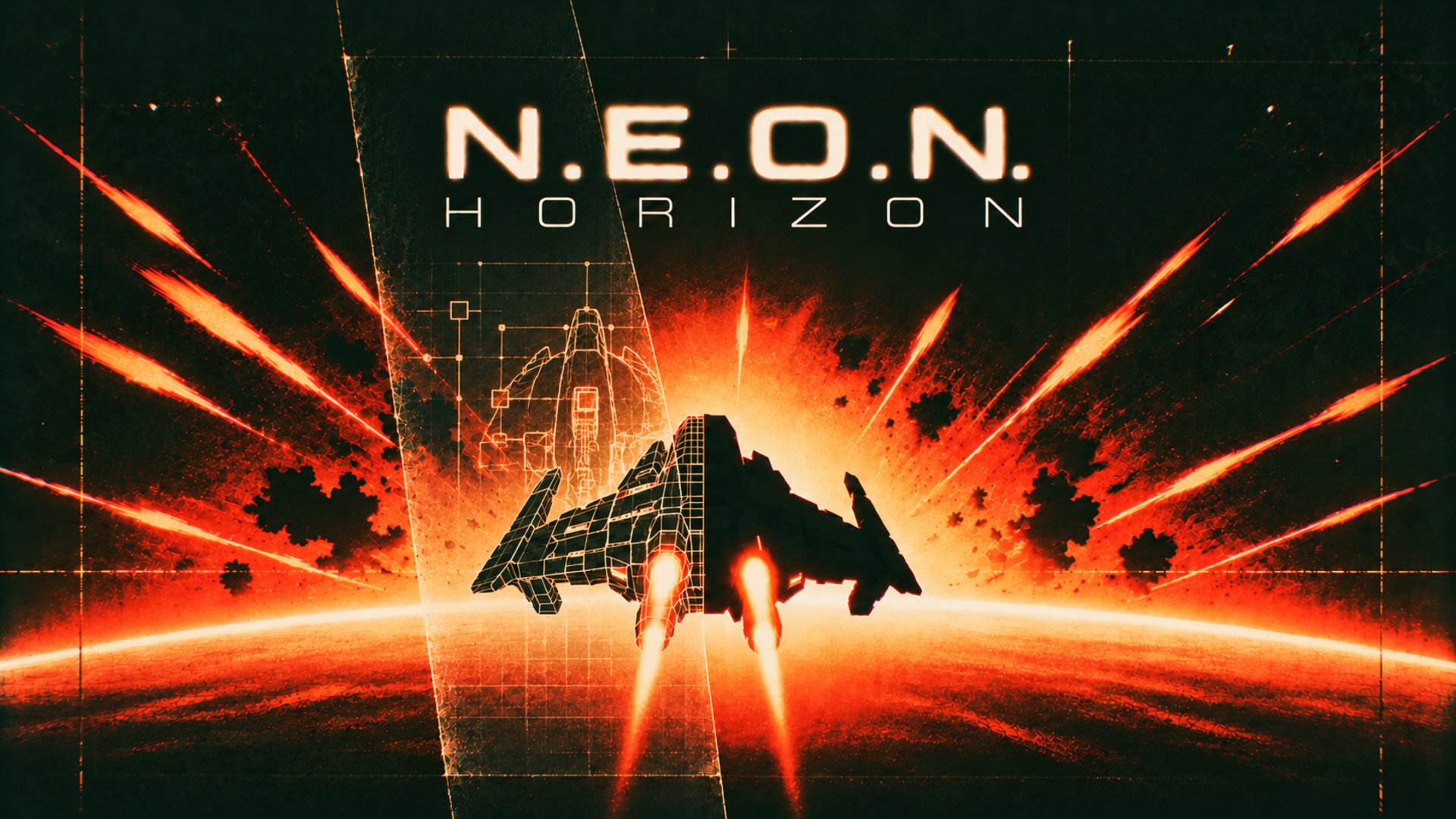
Developer interview: seven original written questions answered by Denis of NeonGameStudio. Answers are reproduced in full with email formatting adjusted for readability. This feature is based on direct correspondence and official promotional material, not an independent hands-on review or scored verdict. Personal background shared separately from these questions has not been included.
The full seven-question interview
1. What was the original spark for N.E.O.N. HORIZON, and which games or ideas inspired its direction?
The idea itself had been in my head for quite a long time. At first, I definitely didn’t have the skills to make it happen, and by the time I had developed those skills, I found myself seriously lacking the time. 🙂
Now I finally have the time — which isn’t necessarily a good thing financially, but it does give me the freedom to actually work on it.
I think the real spark that pushed me to start developing the game came one day when I simply couldn’t find a game in this genre that I actually wanted to play. There’s a saying: “If you’re going to criticize something, offer an alternative.” So I suppose that’s what I decided to do.
I’ve always been drawn to the roguelite genre because it can look quite simple from the player’s perspective, while underneath there are all these hidden mechanics the player never really sees. You can only sense or guess that they’re there, but they’re exactly what makes the game feel satisfying and engaging.
As for specific reference points… I’d say Crimsonland was probably the very first one for me. Among more modern games, of course, Vampire Survivors and Brotato.
2. How did you approach combining bullet-hell action with roguelite progression?
This question actually made me stop and think for a moment. 🙂
I think this particular combination came naturally from the games I’ve played and enjoyed over the years. But there was always something I wanted to add — or, on the contrary, something I wanted to remove.
Progression in N.E.O.N. HORIZON has several layers:
– Progression during combat.
– Progression outside of combat — constructing and upgrading your ship.
– Progression and adaptation of the world itself, which in turn forces the player to adapt as well. Right now, this mostly happens behind the scenes, but with the Act 2 update it will become much more explicit and visible.
The bullet-hell side of the game, meanwhile, is meant to demonstrate to the player that all of that progression actually mattered. Its purpose isn’t simply to overwhelm or destroy the player, but to put them in situations that show how far they’ve come — where their build and their own skill allow them to deal with threats that would have seemed impossible earlier, when they were barely surviving against much weaker enemies.
3. What makes a successful run feel different from the run before it?
Right now, only Act 1 is available in the game. In many ways, it’s meant to teach the player how everything works — although I’ve seen games with considerably less content call themselves finished projects. 🙂
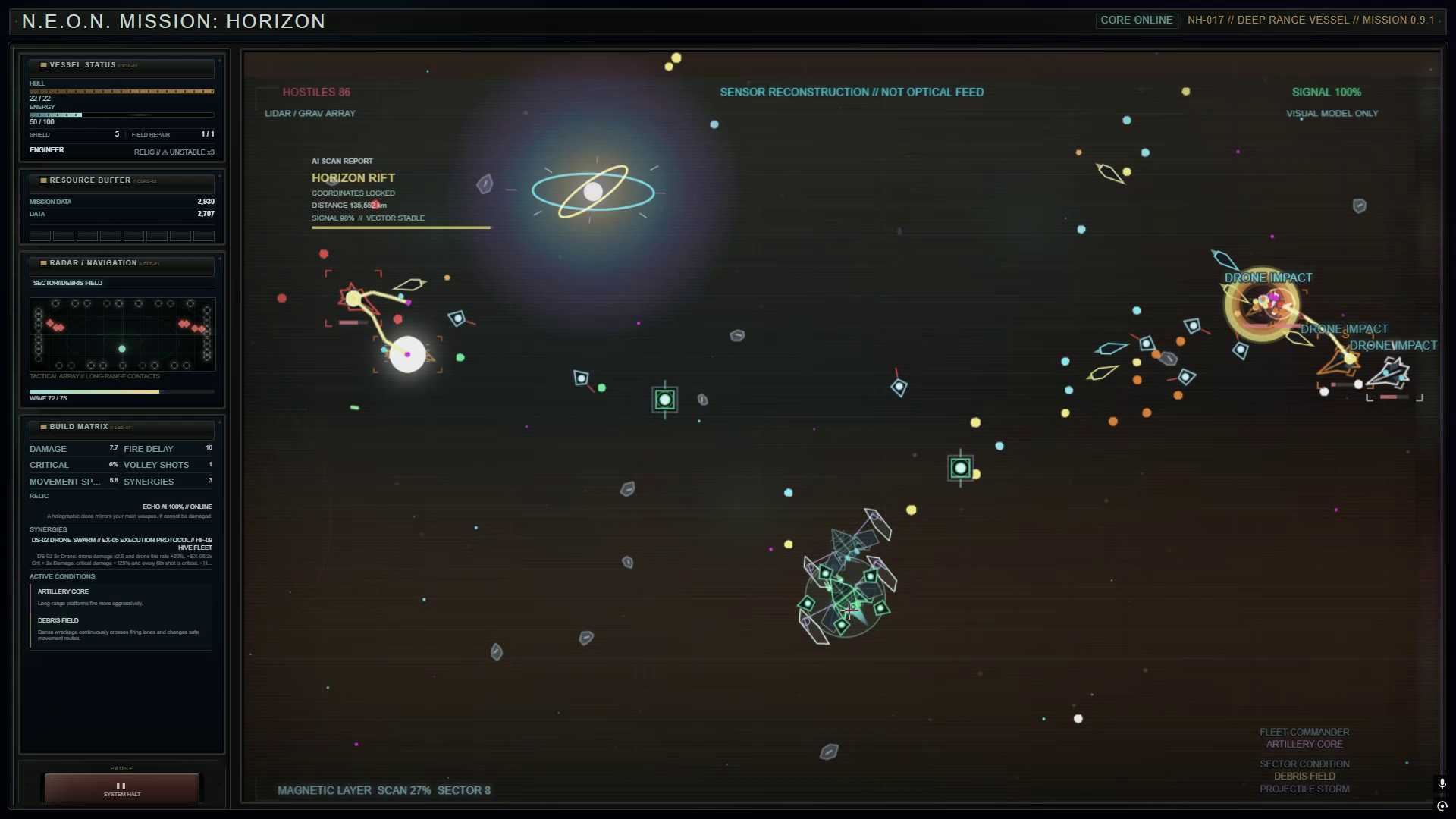
At the beginning of every run, the game randomly selects an AI behavior matrix for the enemies. This affects both which enemies you encounter and how they behave. I actually had to put quite a lot of work into teaching them not to simply charge straight at the player, but to use different tactics instead.
Each biome is also more than just a change of scenery. It has its own parameters that can either help the player or make the run more difficult.
Anomalies are another fun part of a run. They temporarily change the way both you and your enemies have to fight. There are quite a few different anomalies, but no more than two can appear during a single run.
There are also run events. Some are obvious — you see them and immediately understand what’s happening — while others are hidden and only trigger when certain conditions are met.
And on top of all that, as I mentioned earlier, the world itself adapts and evolves as you progress. New enemies can appear — there aren’t that many of them yet, since this system is primarily intended for Act 2 — along with new mutations and new threats.
So even after a successful run, the next one isn’t simply the same challenge with bigger numbers. A different combination of enemy behavior, biomes, anomalies, events, and the evolving state of the world can create a very different situation for the player.
Act 2 will take this idea much further. It won’t simply be another run from Wave 1 to Wave N. It’s going to be much closer to a sandbox.
I’ve almost finished its mathematical model, and within the next few days I’ll start turning that model into something the player can actually see and interact with.
As I envision it today, Act 2 will have a life of its own. The player will have an overarching objective, but there won’t be a prescribed way to achieve it.
4. Which game systems have been hardest to balance as a solo developer?
Balance has probably been the hardest part of the game. That’s simply true.
At first, I tried to find some kind of middle ground… but I constantly ended up hearing either “It’s too easy” or “It’s too difficult.” At some point, I almost stopped understanding what I was supposed to do with it. 🙂
Then someone I know told me something that has since become one of the principles behind the game: “Perfect balance doesn’t exist. Everyone is different.”
That’s actually where the idea of the adaptive world came from. 🙂
I still don’t want to turn the project into a hardcore game — although there is a button for that in the settings, if you happen to want it… — so instead, I’m trying to make it enjoyable both for people who simply want to relax with the game and for those who are looking for a challenge.
Perfect balance doesn’t exist. I’m just trying to make the game interesting for different kinds of players.
5. What did you learn from players during Steam Next Fest, and what are you changing for the planned demo refresh?
Steam Next Fest wasn’t exactly spectacular for me, but I wasn’t expecting some huge boost either, especially with essentially no advertising budget.
What it did give me, though, was the most important thing I need at this stage: actual player feedback. It revealed problems that I can no longer see myself, because the project has become completely “transparent” to me — I know how everything is supposed to work, so it’s increasingly difficult to look at it through the eyes of someone launching it for the first time.
Two important issues became clear. The first was that new players could feel confused during their first launch. The second was that some players wanted the ability to control not only the movement of the ship, but also its aiming and firing.
In the upcoming update, I’ll try to address both. I’m simplifying the steps leading up to the first battle and making the player’s options and actions clearer. I’m also adding a fully manual control mode for the ship.
After that, it’s back to developing the project: new content and expanding what’s already there. And, of course, I try to react quickly whenever bugs or other problems with the game are discovered.
6. What has developing a game independently taught you about building an audience without a big marketing budget?
Patience, self-discipline, and faith in people. 🙂
Today, promoting a project without financial backing is probably a harder task than creating the project itself — at least in terms of how much effort you put in compared to what you get back.
**Patience:**
The first thing you simply have to accept when you’re trying to promote a project without money is that quite often, people will ask you for money. 🙂
The other common outcome is that you’ll simply be ignored.
Together, those probably account for about 95% of all the people you reach out to. And I think the important thing is to accept that as part of the process, not take it personally, and not give up.
**Self-discipline:**
Even when it starts to feel like nobody needs you or your project, you have to push past that feeling and keep trying. Ten times, twenty times, a hundred times, or more. Often you have to make yourself do it, because morale is a fragile thing.
I don’t know how other developers approach this, but I eventually made another decision for myself. I’m not a marketer, and I can’t sell someone a pen for a million dollars, so I simply try to write honestly and directly. I try to be sincere and open.
Marketing people might be shaking their heads at this point and telling me that I’m losing a lot of potential contacts this way.
Maybe I am.
But it allows me to remain honest in the conversations that follow instead of inventing fantastic promises. And if someone does respond positively to my initial message, communicating with them afterwards becomes much easier.
**Faith in people:**
And then, after some number of attempts, someone answers.
Sometimes it’s a fairly formal response, but they’re still willing to react positively to your request and give the project a mention.
And sometimes you find people who are genuinely interested and who try to help with whatever resources they have available. I’m not talking about money. I’m talking about giving your ideas and your project some visibility.
In my experience, there aren’t many people like that compared with the number of people you have to contact. But every single one of them restores some of your faith that this might actually work — and that all the effort you’re putting into it isn’t for nothing.
7. What would you most like new players to notice when they step into N.E.O.N. HORIZON?
That’s another difficult question, because ideally, I’d like players to appreciate the game as a whole. 🙂
At the moment, I think the runs themselves should simply feel good to play, and I hope they do.
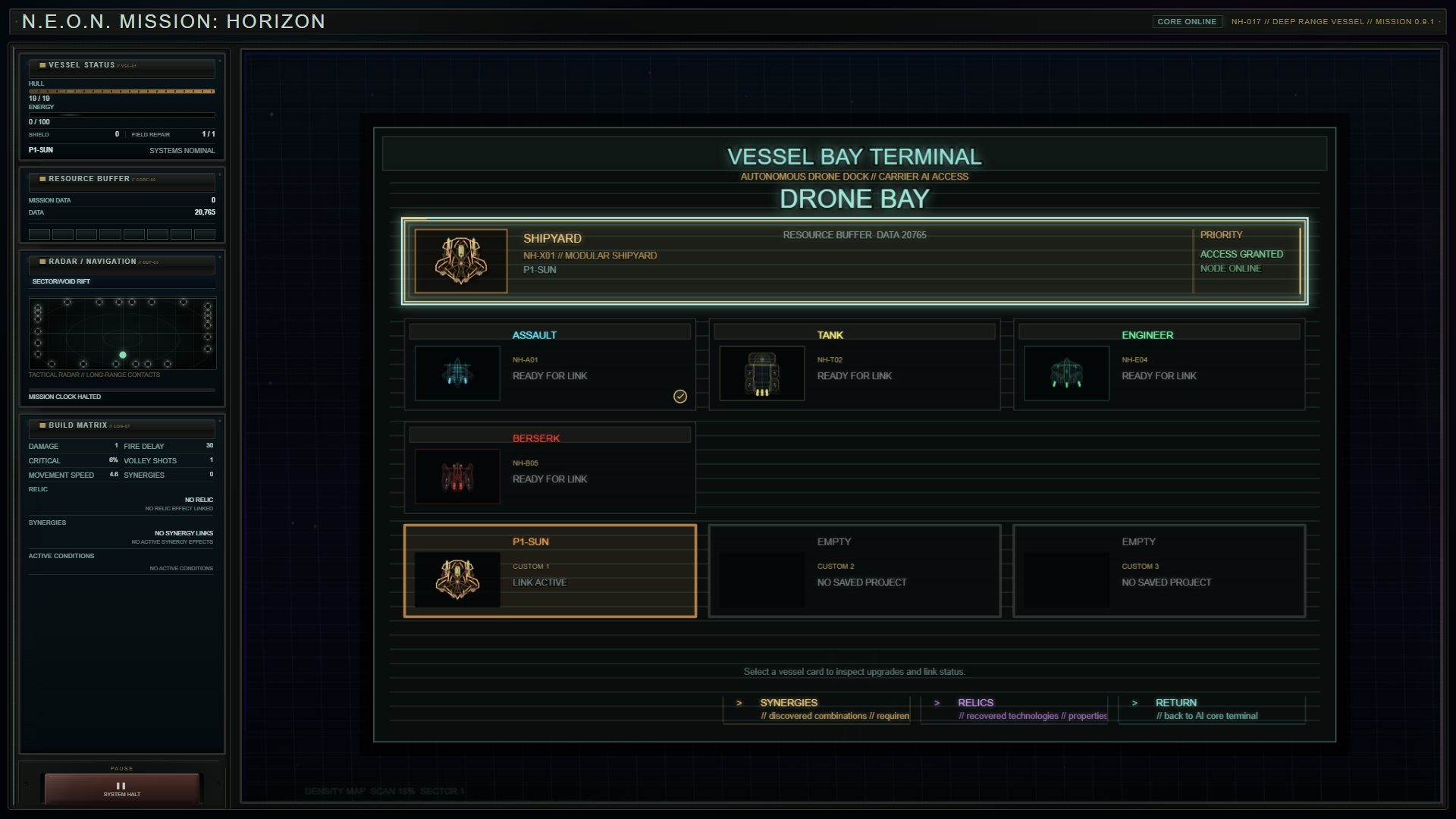
But I’d especially like players to notice the Shipyard — the ship construction system. You’re not limited to simply connecting modules together; you can create almost any design your imagination comes up with, share it with the community, and then try to make your way to HORIZON in a ship that is truly your own.
I’m also planning to keep expanding the construction system in upcoming updates, giving players even more freedom to experiment and turn their ideas into actual ships.
In the end, though, the most important thing is simply that players enjoy their time with the game. That’s what I’m trying to achieve.
Build a ship, then survive the consequences
The developer describes N.E.O.N. HORIZON as a work in progress. Its publicly available Steam demo includes the first act, shipbuilding, different combat conditions and an evolving set of encounters. The game’s second act, more extensive adaptive world and expanded ship construction are developer plans, not currently verified launch features.
Explore the official Steam page and free demo. We thank Denis for sharing such an extensive, reflective account of independent development. Our editorial treatment remains independent, and publication of a developer interview does not constitute a review.
Interview responses received 28 October 2026. Image: official Steam promotional art, NeonGameStudio. Release timing remains unconfirmed; please consult the developer’s current storefront for updates.