
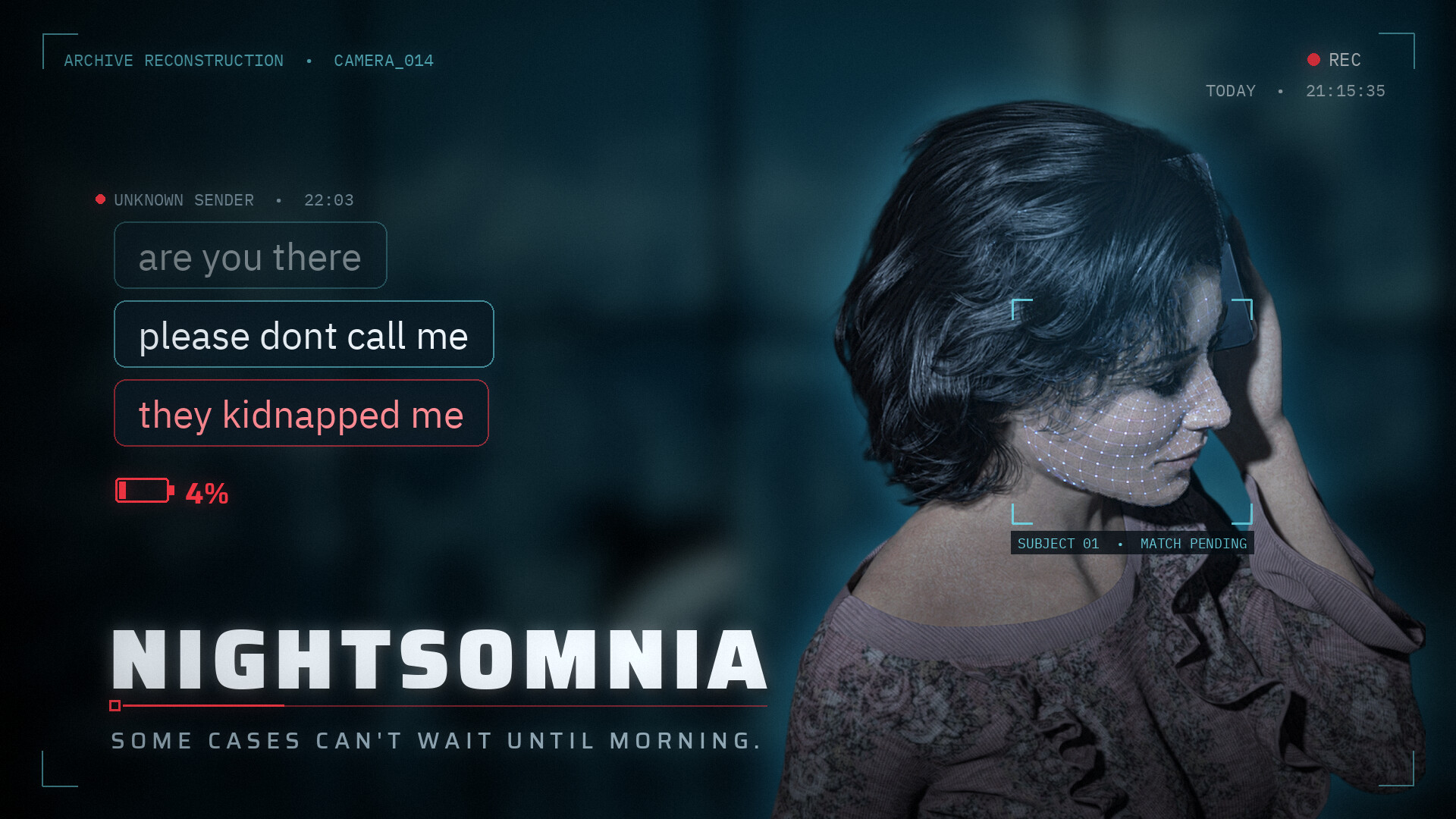
A kidnapping, a fading phone battery, and a lonely desk at night. NIGHTSOMNIA asks players to make life-changing investigative decisions without following an objective-marker trail. In this original seven-question conversation, solo developer Dmytro Osypiuk discusses the uncertainty behind its crisis-analyst premise.
The developer draws on years working in financial analytics and investigative work, rather than law enforcement, and on the experience of developing his own game after hours. Our conversation explores the CCTV, mapping and evidence tools, the value of incomplete information, and what volunteer testers taught him about letting a case go wrong without making players feel cheated.
Original seven-question written interview with solo developer Dmytro Osypiuk. The answers are presented in his own words. The official promotional imagery is credited to the developer; the private preview build and unpublished gameplay footage are not reproduced. The public demo is planned for January 2027 and the full release for Q3 2027, both provisional. This is an interview, not a scored or hands-on review.
The full developer interview
1. What sparked the initial idea for NIGHTSOMNIA, and why choose a night-shift analyst as the player’s viewpoint?
I’d wanted to make a game where players could really immerse themselves in an investigation — searching for clues, analyzing information, connecting the dots, and knowing that their decisions could directly affect someone’s life.
I also wanted the player to feel the weight of that responsibility without getting distracted by the routine tasks of a normal working day. That’s where the night shift came in. You’re alone at your workstation, the rest of the office is quiet, and there’s no one sitting next to you to tell you what to do. Most cases need to be resolved before dawn, which also gives the night setting a certain symbolism. You’re dealing with emergencies that often unfold under the cover of darkness.
There’s another important detail about the main character, John Knox. He’s not an experienced desk analyst who knows every system inside out. He’s actually a former field agent who was reassigned to office work for medical reasons. So, just like the player, he’s learning how to handle this new role and gradually becoming familiar with the tools available to him.
And there’s a more personal reason for choosing the night shift: I developed most of NIGHTSOMNIA late at night myself, after finishing my regular job. So I suppose the setting came quite naturally to me.
2. The opening emergency unfolds through messages and a rapidly draining phone battery. How did you design that sense of urgency?
I wanted the tension to come from the situation itself, rather than constantly pushing the player with a countdown.
You’re in contact with a kidnapped woman who doesn’t know where she is. Her phone battery is running low, and that phone is your only direct connection to her. You need to keep her calm, ask the right questions, gather information, and figure out where she might be.
But there’s something important about how the investigation is structured. Early on, I actually want players to take their time. They can examine evidence, explore different leads, and think things through without feeling rushed. The pressure is there because you understand what’s at stake, not because the game is constantly telling you to hurry up.
As the situation develops, that changes. The decisions you’ve made, the information you’ve gathered, and perhaps the details you’ve overlooked start to matter much more. Eventually, you have to act on what you know.
For me, that’s where the real tension comes from. Not simply running out of time, but realizing that you might have to make a life-changing decision without knowing whether you’ve understood everything correctly.
3. How do you balance player freedom with making sure a detective investigation is understandable without objective markers?
This was one of the biggest challenges during development.
I want players to decide for themselves what to investigate, which clues are worth following, who to contact, and what questions to ask. The game doesn’t give you a checklist of objectives or tell you which tool to open next.
At the same time, I don’t want players to feel completely lost.
One solution I came up with was the investigator’s journal. Depending on what the player discovers, John occasionally records his own thoughts and observations. These aren’t direct instructions. They’re more like reflections that might help you realize you’ve found something important, overlooked a detail, or reached a point where it makes sense to move forward.
I think there’s a big difference between helping someone understand the investigation and telling them how to solve it.
My goal is to give players enough context to make their own decisions, while leaving the actual detective work in their hands.
4. What research or inspirations informed the CCTV, mapping, phone tracing and evidence tools?
I’ve spent many years working in analytics and investigating potential misconduct, although my professional background is in the financial sector rather than law enforcement.
That experience definitely influenced how I approached NIGHTSOMNIA. I’m used to working with databases, examining information from different sources, and understanding how one small detail can completely change the direction of an investigation.
Of course, the tools in the game are very different from the ones I use professionally. NCI is also a fictional federal agency, even though there are real-world organizations with some comparable responsibilities.
I could have added many more investigative systems, but I deliberately kept the selection manageable. I didn’t want players to spend all their time learning complicated software. The tools are important, but the heart of the game is the investigation itself — the tension, the uncertainty, and the feeling that someone is depending on you.
The interactive map was probably the biggest technical challenge for me. I spent a lot of time experimenting with ways to integrate a detailed, functional map into the analyst’s workstation. Eventually, I settled on using a real map of a small American city, which I adapted for the game while respecting its licensing requirements.
Getting that system to work the way I wanted was quite an undertaking, but I’m really happy with the result.
5. How do you make wrong assumptions and missed leads meaningful without leaving players feeling arbitrarily punished?
I thought about this a lot when I started designing the investigation.
I didn’t want a game where missing one clue automatically means you’ve failed, or where choosing the wrong dialogue option suddenly locks you out of a good outcome.
Most evidence can be discovered at different stages of the investigation, and players have a lot of freedom in how they approach the case. What they find can also influence their conversations with the victim and the field agents.
But the situation doesn’t stand still. Some opportunities only exist at certain moments, because events are happening and people are moving. Information that was available earlier might not be available later.
So the player has to work with whatever they’ve managed to uncover.
Importantly, you don’t need to find every single clue to solve a case successfully. You can reach the right conclusion with incomplete information. But the less you know, the harder it becomes to make that final decision with confidence.
I wanted mistakes to have consequences without making the player feel that the game was deliberately setting them up to fail.
6. What did you learn from the volunteers who tested your first case, and what changed as a result?
I initially worked with paid testers, who helped me identify a few inconsistencies in the story and some technical bugs.
But the feedback from volunteer testers was especially valuable to me. By that point, my biggest concern wasn’t whether the game worked technically. I wanted to know whether people would actually enjoy spending so much time sitting behind a virtual workstation, investigating a case through messages, databases, cameras, and maps.
It was genuinely encouraging to hear that people enjoyed the concept, the story, and the atmosphere. But the tests also showed me something important: the workstation could be overwhelming at first.
There are quite a few tools, and new players don’t immediately know where everything is or how to use it. That led me to add a few short, optional on-screen hints that introduce the different tools and explain what they’re used for. Players can simply skip them if they prefer to figure things out on their own.
I also noticed that some testers kept searching for clues in places where they’d already found everything available. That helped shape the investigator’s journal, which can gently suggest when it’s time to move on without revealing what to do next.
The most interesting result, though, was that three out of four early testers didn’t successfully complete the first case on their first attempt. None of them found every clue.
What surprised me was their reaction. They weren’t upset about failing. They didn’t feel cheated or punished. They seemed to appreciate that the story simply continued and that their decisions had led to a different outcome.
That meant a lot to me, because it’s exactly the kind of experience I wanted to create.
I could have taken those results as a reason to make the investigation much easier. Instead, I decided to focus on making the tools clearer and the experience more intuitive, while keeping the challenge of the investigation itself.
After all, finding every clue should be an achievement, not a requirement for enjoying the game.
7. Looking toward the planned January demo and eventual release, what experience do you most want players to remember?
More than anything, I want players to remember those moments when something suddenly clicks.
Maybe they’ve been looking at a photograph for several minutes and finally notice a detail they completely missed. Or they connect two pieces of information from different sources and realize they’ve discovered something the game never explicitly pointed out to them.
I love the idea of a player thinking, “Wait a minute… what if I check this?” and then finding out that their suspicion was right.
Those discoveries can lead to new conversations, unexpected scenes, or even characters they might never have encountered otherwise.
But most importantly, I want players to feel that their conclusions genuinely matter. That they weren’t just following a story someone had already laid out for them.
They were the ones who investigated the case, made the decisions, and ultimately influenced what happened to the people involved.
If players finish NIGHTSOMNIA feeling that way, I’ll consider that a success.
Discover NIGHTSOMNIA
The developer has an official press kit with editorial-approved materials and a Steam listing. Coloured Static Press has not used or publicly shared the developer-controlled preview build, and any public gameplay capture or story spoilers must be discussed with the developer before publication.
Interview responses received 28 October 2026. Images: official NIGHTSOMNIA artwork and promotional footage imagery, Dmytro Osypiuk. Release details are plans, not confirmed launch dates. Coloured Static Press has not published or redistributed the private preview build.