
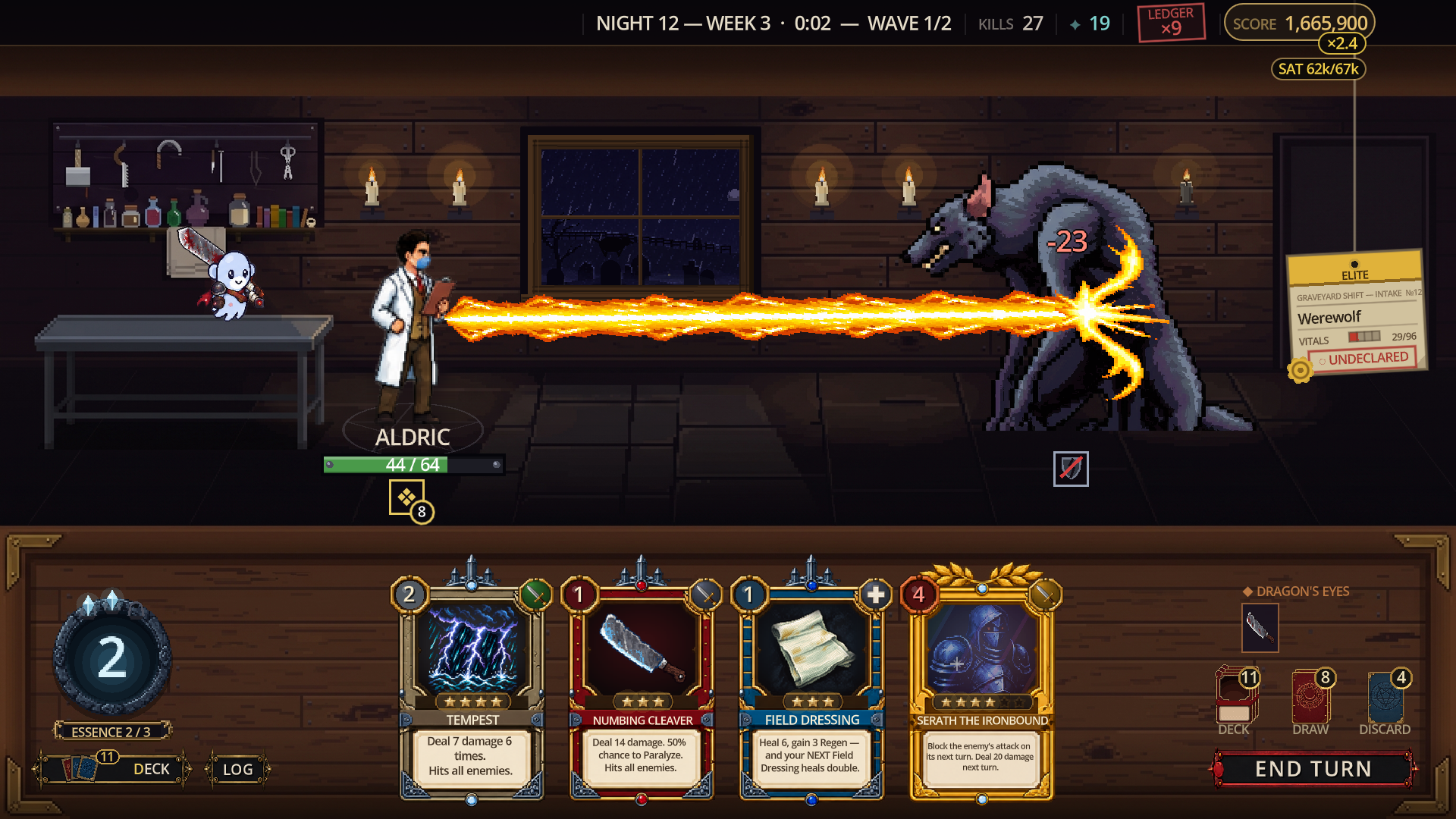
One developer. A haunted morgue. Twenty-two nights standing between Aldric and the dead.
We spoke to Jonathan Cerrato, the Canadian founder and developer of MonkeyMan Games, about Graveyard Shift: A Sage’s Last Stand, from its unusual deckbuilding mechanics and hidden lore to the personal journey of building a game around a full-time job.
The questions below are those sent by Coloured Static Press. Jonathan’s responses are reproduced in full, with formatting adjustments only. Game features and figures are the developer’s own descriptions, not claims independently verified through hands-on play. A separate review will follow.
Could you introduce yourself and Monkeyman Games? What led you into making games, and how did Graveyard Shift become the project you wanted to bring to life?
I’m Jonathan Cerrato, and MonkeyMan Games is me. I’m based in Canada. By day I’m an IT tech at an MSP, a company that looks after other businesses’ computers and networks. I wanted a way out of the 9-to-5, and the best way I could think of was to make something of my own and put it out into the world. Graveyard Shift is that something.
It started small. The first version was a single-page game that ran in a web browser. It had a morgue, an intake table and a deck of cards, and not much else. I kept playing it after I meant to stop, which I took as a sign. This summer I rebuilt the whole thing properly for Steam, and it has grown a lot since then. It’s the first game I’ve put out under the studio name, and I wanted it to be something I’d actually buy.
A mortician defending a morgue through a gothic roguelike deckbuilder is such a distinctive premise. Where did the original idea come from, and which part of it took shape first?
It started with what I like to play. I’ve always enjoyed deckbuilders, and I’ve always loved a good game I can play on a handheld when I get the chance. So I set out to make the kind of game I’d want for myself: a deckbuilder you can pick up for one more night, whether you’re at a desk or on the couch with a Steam Deck.
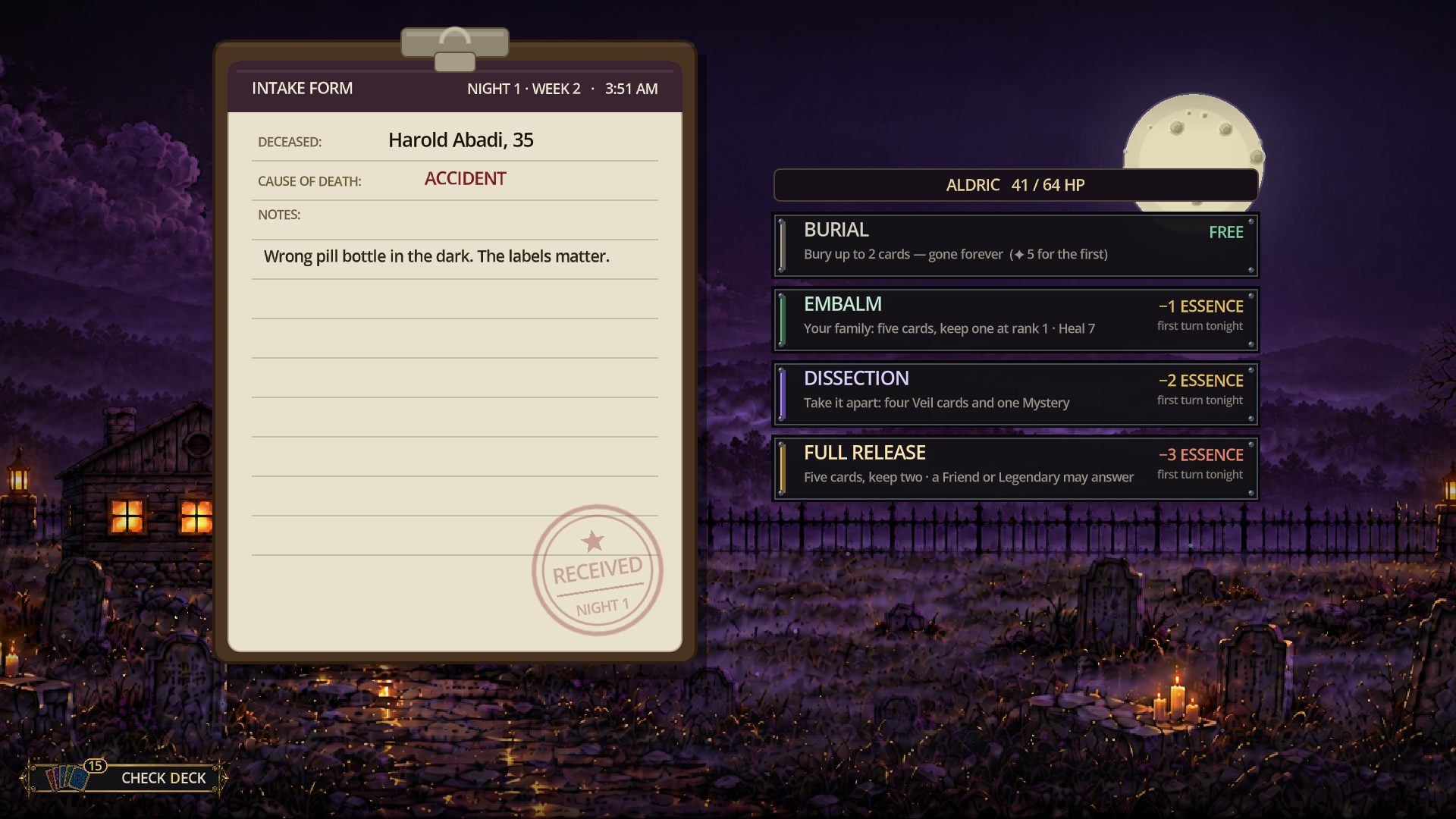
The morgue came first. Before Aldric had a backstory, before there was any magic, there was the intake table: a body comes in, you read the form, and you decide what to do with it. Everybody has a name, an age, a cause of death and a short note. "Wrong pill bottle in the dark. The labels matter." That little form set the tone for everything else. It’s a bit sad and a bit dry, and the job still has to get done.
The fantasy side came later. Once I asked who would actually take a night shift like this, and why he never complains about the hours, Aldric started to exist.
Tell us about Aldric. Who is he outside his very unusual night shift, and how does his story come through as players survive each night?
There is a funeral home at the edge of town, beside the graveyard. Aldric works its nights. He turned up with no past he would talk about, asked for the night shift, and has never once complained about the hours. The town is glad it isn’t them.
What the town doesn’t know is that Aldric isn’t from here. He’s a Battle Sage from a world called the Veil, where soul magic was taught in schools the way we teach trades. There were five of them: Vengeance, Chaos, Wisdom, Plague and the Veil itself. He trained in all of them. Thirty years ago the Veil fell. He saw it coming before anyone else and tried to hold it together, and he couldn’t. On the last night, a handful of them ran for the last gate out. Most of his friends died getting the others there. He was the only one who made it through.
Why a funeral home? Whatever tore the Veil open only lets things through where death runs thick, and a hundred years of the town’s dead have passed through that house on their way into the ground. It’s a door that never quite shuts. Things climb out of a tear at the edge of the yard every night and walk toward the lights of the house, and he’s waiting at the door. The magic he fights with comes from the bodies on his table. The game’s lore book describes it as "the way warmth stays in a chair after someone stands up." He handles it with care.
Outside the shift he’s quiet, a little stubborn and very private. After closing he puts on old soul, jazz and blues records he found after he came here, and hums along badly. He has company he didn’t ask for: a troop of small ghost monkeys from the temples back home, who followed him through because his heartbeat was the last familiar rhythm in their world. Old friends from the Veil turn up too, as Legendary cards.
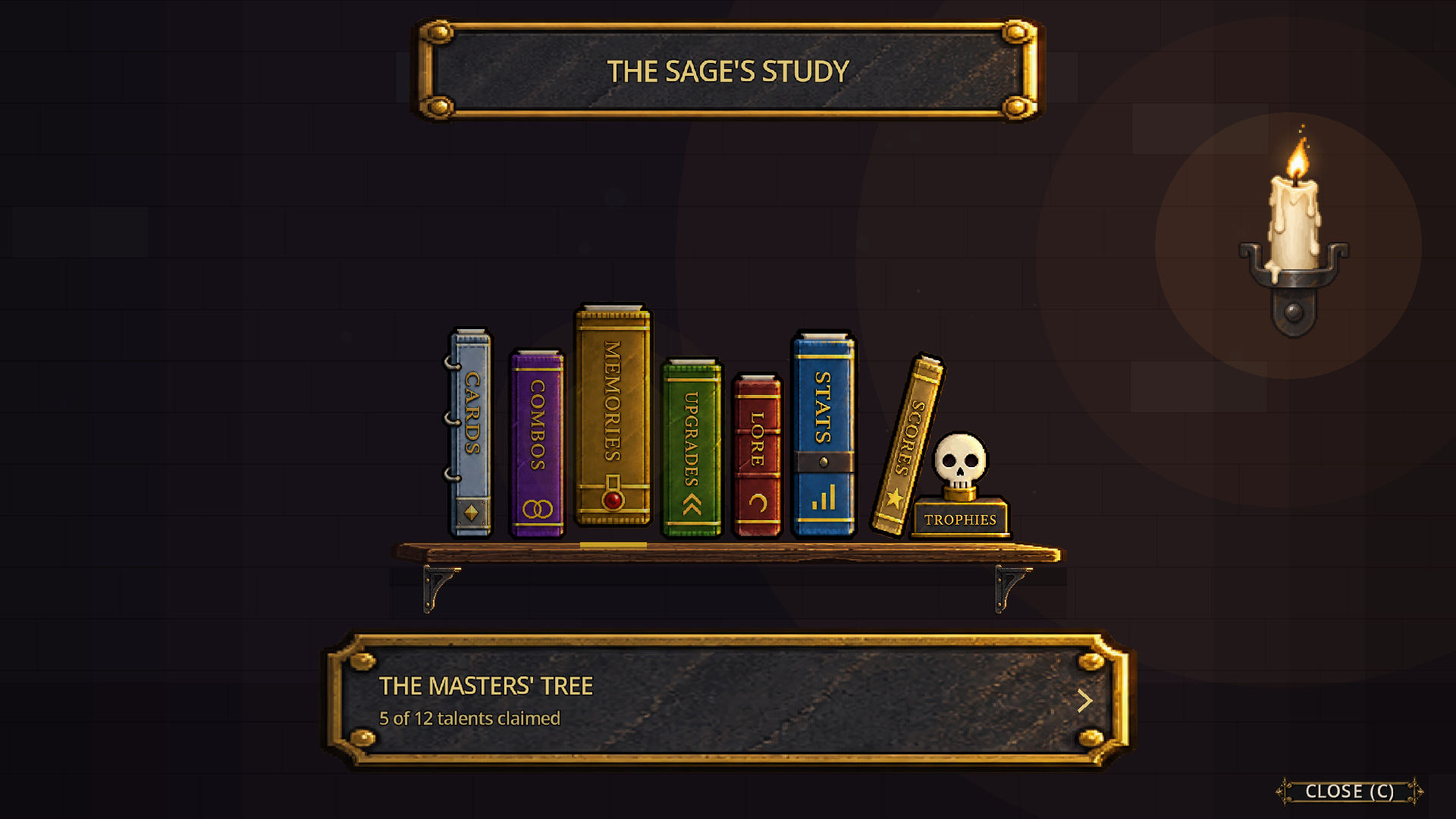
Players learn all of this through that lore book. It’s called What the Dead Carried, and it sits on the shelf in the Sage’s Study, the menu screen with the books on it. It starts mostly empty. A few paragraphs are there from the beginning, and the rest are missing. Each missing one is drawn as faded lines with a small hint about where to find it, like "Fell the Quarry King" or "Keep a chain going". You fill it in by playing. Some pages are written the first time something happens to you: the first night you survive, the first time Aldric falls, each week’s boss, each old friend who answers. Others turn up as notes in the pockets of the dead. The deeper questions, like who closed the Veil and why everything that comes through walks toward his house, are in there too, but you have to go and get them. Once it’s complete it reads as one short book. So if you want the story first-hand, play a few nights and then go and read what you’ve found.
Building a deck from the bodies arriving at the morgue is an intriguing mechanic. How does it work in practice, and what kinds of decisions do players face when choosing how to use those cards?
Before most nights a body comes in for intake, and you pick one of four rites:
Burial (free): Put up to two of your own cards in the ground for good. It sounds like a loss, but it’s one of the strongest things you can do. Every weak card you bury is one less card standing between you and the ones that win fights.
Embalm (1 Essence): Prepare the body properly, and you choose which family of cards it gives you. If your build needs another Vengeance card, you pick the Vengeance pack and see five cards from that family alone. The price is that you can only keep one of them, so you’re trading choice for control. Embalming also patches Aldric up before the night starts.
Dissection (2 Essence): Take the body apart and see what it was hiding. You get four Veil cards and one Mystery card, and you keep two. It’s the way into the Veil, the deepest and strangest of the six families, and into Mystery cards, which don’t show what they really do until you play them.
Full Release (3 Essence): Let the soul go completely. You see five cards from anywhere in the game and keep two. Sometimes something answers: an old friend from the Veil, or a rare Legendary. It’s the biggest gamble at the table, and it costs the most.
The catch is that the better rites cost Essence, and you pay it out of your first turn that night. Full Release can start you three Essence down against whatever just came through the door. So the question is never only "which card do I want". It’s also "how greedy can I afford to be tonight". Two nights a week no body comes at all, and you go straight to the fight with what you’ve got.
On top of that, every card ranks up through stars, and those upgrades are written by hand, so a card can change what it does as it climbs and not only its numbers. Mystery cards roll their own effect copy by copy, and you won’t know what you’ve got until you play one. And some bodies don’t arrive quietly.
Roguelike deckbuilders are a crowded genre. What have you done to give Graveyard Shift its own identity beyond the setting?
A few things I haven’t seen done quite this way.
The chain. Every kill and every multi-hit blow pushes your score multiplier up, all the way to ×5, and one hit from an enemy knocks it back down. When it gets going, a little ghost monkey turns up at Aldric’s shoulder and keeps time with him, and he dresses up the longer it lasts. Get hit, and he’s gone in a puff. People get oddly protective of that monkey.
The Ledger. You can sign debts before a run. Each one makes the run harder in one specific way, like every heal being cut in half, or only twelve turns to kill each enemy, and each one adds to your score multiplier. You decide how much trouble you want to be in.
The night visitors. Between nights, something always happens at the house. A drunk gravedigger wants to make a bet. A man in a very good coat would like to buy a card out of your deck. A black cat is sitting on slab four, and you don’t own a cat. The phone rings at 3 a.m. on a line that’s been dead for years. There are twenty of these, and each one gives you the same choice: play it safe, make a trade or take a gamble.
And the Weekly Shift. Once a week there’s one contract with the same rules for everyone, your own upgrades left at the door, and its own score board. It’s the closest thing the game has to a race.
Underneath all of it, I’ve tried to be stubborn about clarity. Every card has its own page in the in-game book that shows exactly what it does at every rank. If a mechanic happens, the log says so in plain words. A good deckbuilder should never leave you guessing why you died.
The artwork immediately caught our attention. How did you settle on the game’s visual style, and what influences helped shape that gothic atmosphere?
Thank you. I wanted it to feel like a small funeral home at night: one lamp on, rain on the window, tools on the wall, candles burning down, and a purple graveyard outside that you only really see between shifts. The interface is iron and candlelight, so the menus feel like part of the building and not something laid over the top of it.
I’m not a trained illustrator, and I won’t pretend to be. The game is built on pixel art licensed from a lot of talented independent artists, all credited by name in the game, and a great deal of it has been reworked, redrawn and recoloured so it sits together as one world. I also used some AI-assisted tools as part of that process, which is noted on the Steam page.
What has been the biggest challenge in developing the game independently? Has there been a particular problem you were especially proud to solve?
The hardest part is being in every department at once. Design, programming, art direction, sound, the store page, the trailer, taxes, support. Something is always waiting.
The problem I’m proudest of is a small one. One of our testers was playing on a graphics card more than ten years old, and two hours into a session every word on screen turned into scrambled glyphs. Nothing in the logs explained it. It turned out the game was keeping every monster animation it had ever loaded in video memory for the whole session, and on a card that small it eventually ran out of room. Now each night lets go of the art it no longer needs, and long sessions are much lighter on older machines. Nobody will ever notice that fix, and that’s exactly why I like it.
What I’m proudest of overall is the card animations. There are more than 150 of them, and every card gets its own. No card borrows another card’s effect. Death’s Jackpot rolls a slot machine and pays out in lasers. Kaelen’s beam crosses the whole room, and once she reaches her Ascended form she fires it twice. It would have been much faster to reuse a handful of effects, and most players would never have complained. But in a card game, the moment you play a card is the moment that matters, and I wanted every one of them to feel like it was made for that card. That was a lot of late nights.
The Steam Next Fest demo has given players a chance to try the game. Have any reactions surprised you or changed what you plan to focus on during Early Access?
I’ll be honest, Next Fest was quieter for us than I hoped. The demo picked up about a hundred new wishlists over the four days, which is something, but it’s a huge festival and a one-person studio with no marketing budget is easy to miss. I don’t think it got the spotlight it deserved, and that’s part of why an interview like this means a lot to me.
The good news is what happens once people get past the demo. The testers who have been playing the full game love it, and some of them are more than eighty hours in. That tells me more than any wishlist count.
What has surprised me most is how specific people are. A lot of the game changed because someone wrote one clear sentence. Testers told me they wanted to pick their new card before the end-of-night tally, so now the card comes first. A player who lost a run to their own card asked to read the fight log from the Game Over screen, and that went in the next day.
Not every request goes in. One player asked to keep their turn after a kill, so they could go straight into the next enemy. I understood why, but a kill resetting the turn is a core part of how fights are paced, so it stays. It’s fine to say no as long as you explain why.
What it’s changed for Early Access is mostly priorities. Clarity first, then content. If players can’t tell why something happened, that gets fixed before anything new goes in.
Graveyard Shift enters Early Access on 27 October. What will be there on day one, and which parts of the game are you most excited to develop further with the community?
I should say up front that the Early Access label undersells this one a little. The game is already very full, and it’s close to what I’d call 1.0. I went with Early Access because I want real players in it for a while before I put that number on it, not because big pieces are missing.
On day one you get the full month: twenty-two nights over four weeks. The first three weeks are fought inside the morgue, and each one ends with a boss: the Coroner, the Quarry King and the Veil Tyrant. In the fourth week Aldric finally steps outside, and the month ends in one of two different invasions, each with its own final boss. And there’s something with no name, for anyone who goes looking. Finish a month and the next one comes back harder.
Inside a run there are 147 cards across six families, every one with its own star ranks to climb, and the Legendaries go all the way to an Ascended form. There are about 110 creatures, 67 named combos, twenty night visitors, eleven potions for Aldric’s belt, a shop on Wednesdays and a market on weekends.
Between runs there’s a lot to come back for. The morgue itself has four tiers of permanent upgrades. The Ledger has 29 boons to buy for good and 30 debts to sign for a bigger score. The Masters’ Tree has twelve talents you open by beating the month’s masters. The Weekly Shift gives everyone the same contract each week, with its own board. And the Sage’s Study holds a page for every card, the combos you’ve found, your best runs and the lore book.
It also has 95 Steam achievements with progress bars, a worldwide score board, Steam Cloud saves, and full controller and Steam Deck support. If you played the demo, what you earned there comes with you.
So the road to 1.0 is mostly about more, and about getting it right with real players. I’m most excited about new creatures and new old friends. There’s already a vault of monsters waiting for their week on the night shift, and more Legendary companions to bring through from the Veil. The community gets a real say in the order. The roadmap on our site moves when people ask for things, and that isn’t a slogan. Two features this month came straight from player requests.
With controller and Steam Deck support, you’ve clearly thought about different ways to play. Was that important to you from the beginning, or something you added as development progressed?
Honestly, it came later. The browser version was mouse only. But I’ve always loved games I can play on a handheld, so once the game was going to Steam it became non-negotiable, and then it took a lot more work than I expected. A deckbuilder has a lot of small things to click. Every screen had to be reachable with a pad, every button prompt had to show the right glyph for the controller you’re holding, and every layout had to fit the Deck’s taller 16:10 screen without anything falling off the edge.
It’s in a good place now. You can play a whole run without touching a mouse, and on the Deck it feels like it belongs there. A card game you can play in bed is a dangerous thing.
What would you most like players to feel after their first few nights in Aldric’s morgue?
That they want one more night. And then, a bit later, that they want to know why. Why does everything walk toward that house? Why won’t Aldric talk about where he came from? If someone closes the game thinking about that, and then opens the lore book to see what they’ve found, I’ve done my job.
Finally, looking beyond launch, what would success for Graveyard Shift mean to you personally, and is there anything else you’d like our readers to know?
The simple version is that I want to make something people love as much as I do. That would already feel like a win.
Something I didn’t expect along the way: making a game turned out to be more fun for me than playing them. I’ve played games my whole life, so that one caught me off guard.
The honest version is that this is also about my family. Things in Canada aren’t great right now. The cost of living keeps climbing, the job market is rough, and the raises at a regular 9-to-5 rarely keep up. I could have just complained about being stuck. I decided to build something instead, something that could become a second income and give my family more room to breathe. For me, it all comes back to making their lives as good as I can. If Graveyard Shift does that, and lets me keep making games under the MonkeyMan name, that’s success.
For your readers: the demo is free on Steam right now, and the full game opens in Early Access on 27 October. If you find a bug, press the bug button in the game. It really does come straight to me. And if the game sounds like your kind of thing, a wishlist helps a small studio more than you’d think.
One more night
Graveyard Shift: A Sage’s Last Stand is scheduled to enter Early Access on 27 October 2026. Its free demo is available through its official Steam page. You can also learn more at MonkeyMan Games.
Coloured Static Press is preparing a separate, independent full review, following time with the game. This developer interview does not constitute a review score or hands-on verdict.
Editor’s note: This interview was conducted by email with Jonathan Cerrato, Founder and Developer of MonkeyMan Games. Screenshots were supplied directly by the developer, along with a review key. All figures, launch plans and gameplay descriptions in the interview are attributed to Jonathan and may change during Early Access.
Our thanks to Jonathan Cerrato for taking the time to share his story. Discover more original developer interviews in Coloured Static Press Interviews.