
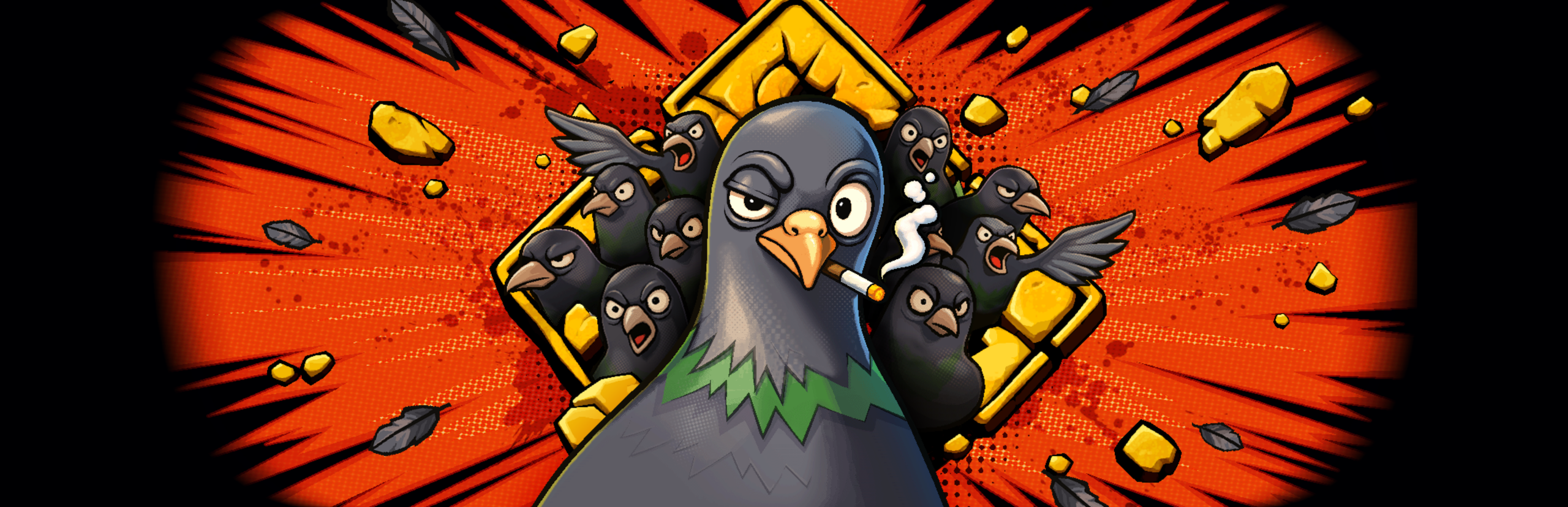
Behind the Signal interview. Answers supplied in writing by Dylan of Decaf Bagel Games. This is not a hands-on review.
What begins with pigeons at a railway station becomes a wave-based roguelite about deliberate risk and unusual builds. We spoke with the solo developer behind Pigeons Must Die about weapon synergies, boss encounters and what player feedback has changed.
What happened first: the idea of surviving pigeon attacks underground, or the wave-based roguelite combat?
The pigeons came first! I was walking past a train station near where I live, and there were pigeons everywhere. Somehow, that sparked the idea of a game where you’re fighting off hordes of pigeons. The wave-based roguelite combat came naturally afterward as I started thinking about how to turn that silly premise into something genuinely fun to play.
How did you decide that weapons should fire automatically, leaving players to focus on movement and build decisions?
I took a lot of inspiration from Brotato. I really like how its small arena and tight gameplay loop strip away unnecessary complexity and let players focus on what matters.
Automatic weapons free up a lot of mental space for players to think about positioning, upgrades, and build decisions. As a developer, it also lets me focus on designing interesting systems like runes, weapon fusion, and Wave Contracts. I wanted the depth to come from the decisions players make, rather than how quickly they can aim and shoot.
What makes socketing runes and fusing weapons a meaningful choice rather than a straight upgrade?
Path of Exile was a huge inspiration here. One of my favorite things about that game is experimenting with different combinations and discovering interactions you didn’t initially expect.
I wanted to bring some of that feeling into Pigeons Must Die. Runes and weapon fusion aren’t just about making numbers bigger. They’re about changing how your weapons behave and creating synergies between different elements and effects.
The goal is to give players room to experiment and discover builds that fit their playstyle. Ideally, there’s no single correct way to build a weapon.
How do Wave Contracts change a run, and how did you tune the risk against the rewards?
I play a lot of Path of Exile, and one concept I really enjoy is “map juicing,” where players can deliberately make content harder in exchange for better rewards. I wanted to capture that same risk-versus-reward decision in a much more compact system, which became Wave Contracts.
Fun fact: In the original implementation, modifiers were completely random and automatically applied every five waves. It sounded interesting on paper, but in practice, it felt terrible when a bad modifier ruined an otherwise perfect run.
That’s when I realized the missing ingredient was player agency. Contracts now let players decide whether they want to take on an additional challenge for better rewards or play it safe and skip it.
I think that choice itself is much more interesting than simply throwing random difficulty spikes at the player.
How did you approach the bosses so they interrupt players’ established tactics rather than simply having more health?
I’ve always preferred bosses with interesting mechanics over bosses that are just giant health bars.
I especially enjoy encounters with recognizable attack patterns and even some raid-like mechanics, where players need to understand what’s happening and react accordingly.
There’s something incredibly satisfying about struggling with a mechanic, learning how it works, and finally executing it correctly.
That’s the feeling I wanted to capture. Bosses should test more than just your damage output. They should challenge your movement, positioning, and ability to adapt, even when you’ve already built a really powerful character.
(There are at least 2 more powerful bosses that were not included in the demo btw.)
What’s been the biggest challenge of solo development, and what has the public demo taught you so far?
Honestly, the biggest challenge is spending too much time inside my own head.
When you’re developing a game mostly by yourself, it’s surprisingly difficult to step back and experience it from a player’s perspective. You start losing the ability to judge whether an idea is actually fun, whether something is balanced, or whether a mechanic even makes sense to someone seeing it for the first time.
To help with that, I built a fairly extensive analytics system into the game, with players opting in to share gameplay data. That gives me something more concrete to work with instead of relying entirely on my own intuition.
Steam Next Fest was especially valuable because it brought in real players and gave me both feedback and gameplay data to analyze.
I’m now using those insights to identify problems, revisit some design decisions, and improve the game for the full release. It’s been a really useful reminder that what makes sense to the developer doesn’t always translate to the player.
What unusual or unexpected build would you love players to try?
Right now, multishot ice builds seem to be dominating the leaderboards, and honestly, they’re really good!
But I’d love to see players experiment with some of the other combinations. For example, try a fire build with Portable Furnace, or a poison-and-blood build that spawns worms. Lightning builds can get pretty ridiculous too.
One of my favorite things about this kind of game is watching players discover combinations and interactions I hadn’t necessarily anticipated.
So my advice is: don’t just copy whatever is at the top of the leaderboard. Experiment a little. There are plenty of powerful builds waiting to be discovered!
Game: Pigeons Must Die on Steam. Artwork credit: Decaf Bagel Games. Developer-supplied artwork is reproduced with permission.