
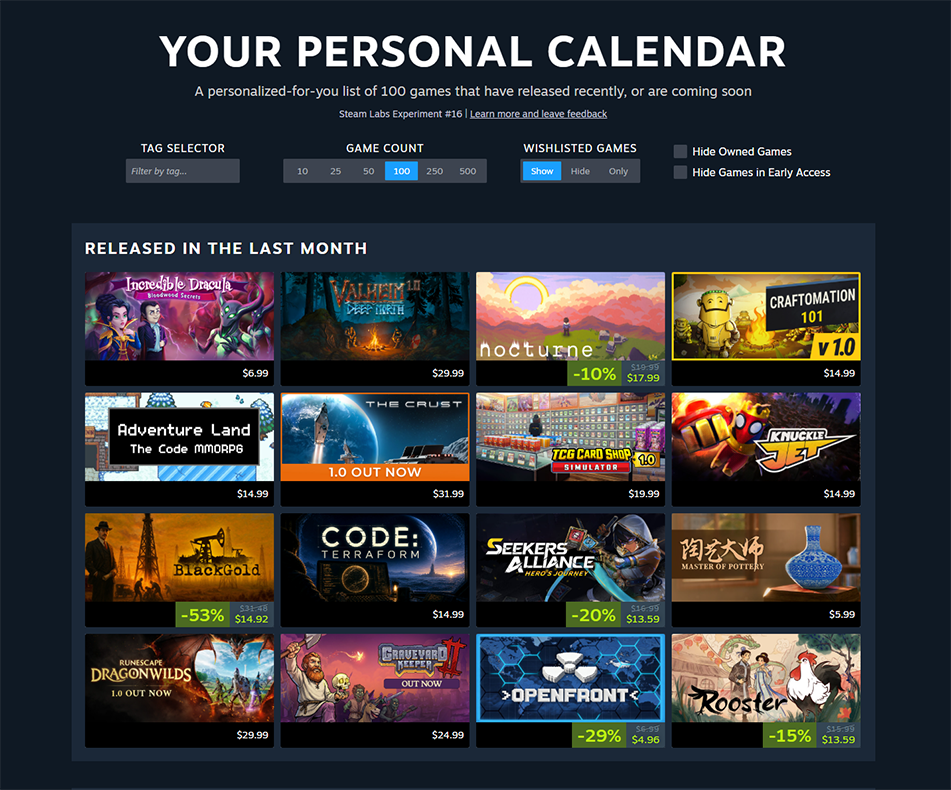
Steam’s Personal Calendar is live. Finding the next game could get easier.
Valve has moved its personalised release calendar out of Steam Labs, creating another route for players to discover games before and after launch.
Steam has a discovery problem familiar to anyone who follows independent games: there are more interesting releases than one person can reasonably keep track of. Valve’s Personal Calendar aims to make that flood more manageable, and on 23 October 2026 it formally graduated from Steam Labs into the main store experience.
The calendar groups upcoming and recently released games by date, but it is not a conventional release list. It prioritises titles Valve thinks an individual player may actually want, drawing on the games that player spends time with and on what players with similar habits are wishlisting or playing.
How the calendar chooses its games
Valve says the feature focuses on meaningful playtime, rather than treating a quick five-minute test of a demo as equal to a favourite game you’ve played for hundreds of hours. It compares those playtime patterns with other users to identify games worth considering.
The calendar also displays wishlisted titles, keeping games a player already intends to follow in sight. Views and filters help distinguish new launches, games leaving Early Access, DLC and other release types. Valve has refined the feature across devices during its time as an experiment.
Importantly, Valve says placement in the Personal Calendar is not sold to publishers or developers. Recommendations are algorithmic and personalised rather than selected by a human editor or purchased as advertising space.
What does this change for indie developers?
At first glance, another discovery surface looks encouraging for developers without blockbuster marketing budgets. A niche game could reach players with a demonstrated interest in similar genres, even if it isn’t dominating a general ‘popular upcoming’ list.
That is a potential opportunity, not a guaranteed traffic boost. Valve has not promised a minimum number of impressions to small studios, and a system based partly on existing play patterns may also favour familiar genres over genuinely surprising ideas. It remains important for developers to maintain accurate store details, release information and a clear pitch for their game’s appeal.
Valve’s Steamworks documentation now explains how developers can approach the feature, including release-date information for titles graduating from Early Access. Those details matter when your release window is crowded.
The difference between an algorithm and an editor
For players, a useful recommendation system can save time. For developers, it may help put a game in front of a relevant audience. But neither replaces the value of someone actually exploring a demo, speaking to its creator and explaining what makes it different.
That is where CSP’s First Signal has a role. Our coverage is editorially selected, built around the game and developer’s story, and is not a promise of automatic publication. Valve can help players find titles resembling what they already love; independent writing can sometimes persuade them to try something they never thought to search for.
CSP perspective: Personal Calendar is a welcome practical addition to Steam’s crowded storefront. The real test is whether it helps players encounter smaller releases, rather than merely rearranging the same familiar recommendations. For indie studios, it’s another tool, not a substitute for an excellent game and a compelling presentation.
Sources and further reading: Valve’s official Personal Calendar launch announcement · Steamworks developer guidance · Try the Personal Calendar.