
One developer. Two worlds. A very lucky cat and a flock of thieves.
Javier Lianes García of Lianes8 Studio talks about Maneki Mania, Pidgeon Pocket, building his own engine and the player feedback that changed both games.
A cat who showers you with koban. Pigeons who steal from the crowds of a busy city park. On paper, Maneki Mania and Pidgeon Pocket could hardly look more different. For Spanish solo developer Javier Lianes García, both are experiments in a deceptively demanding idea: making every upgrade feel meaningful.
Following our First Signal introduction to Maneki Mania and look at Pidgeon Pocket, Javier answered our seven questions about the family origins of the games, how he tests their progression, and what happens when players spot flaws he cannot see himself.

“A number on its own is not a reward. If you buy an upgrade, you need to see it and hear it.”
In conversation with Javier Lianes García
As a solo developer, what first inspired you to build both Maneki Mania and Pidgeon Pocket, and what drew you to incremental games?
Maneki Mania started at home. My wife loves Asian culture and she loves cats, and I wanted to make a game she would really enjoy. She plays in short breaks, a few minutes here and there, so the game had to be fun from the very first tap. A lucky cat at a shrine with slot machines on top fit that really well: you pet the cat, coins come out, things shine and you feel good fast. Pidgeon Pocket started almost as a joke. I asked a friend to help me with my next game and said we could make anything, like pigeons that rob people. And that was it. It became a flock of pickpocket pigeons working a busy city park, stealing coins and shiny things from the crowd and flying the loot home to a rooftop loft. What both games share is the incremental part. I like incrementals because they are short: you order some dinner and you finish one in three or four hours, like Pidgeon Pocket. They are easy, you don’t have to think too much, and they give you a lot of dopamine.
Maneki Mania has a distinctive lucky-cat shrine, koban and fortune-machine theme. How did that visual identity and the central gameplay loop develop?
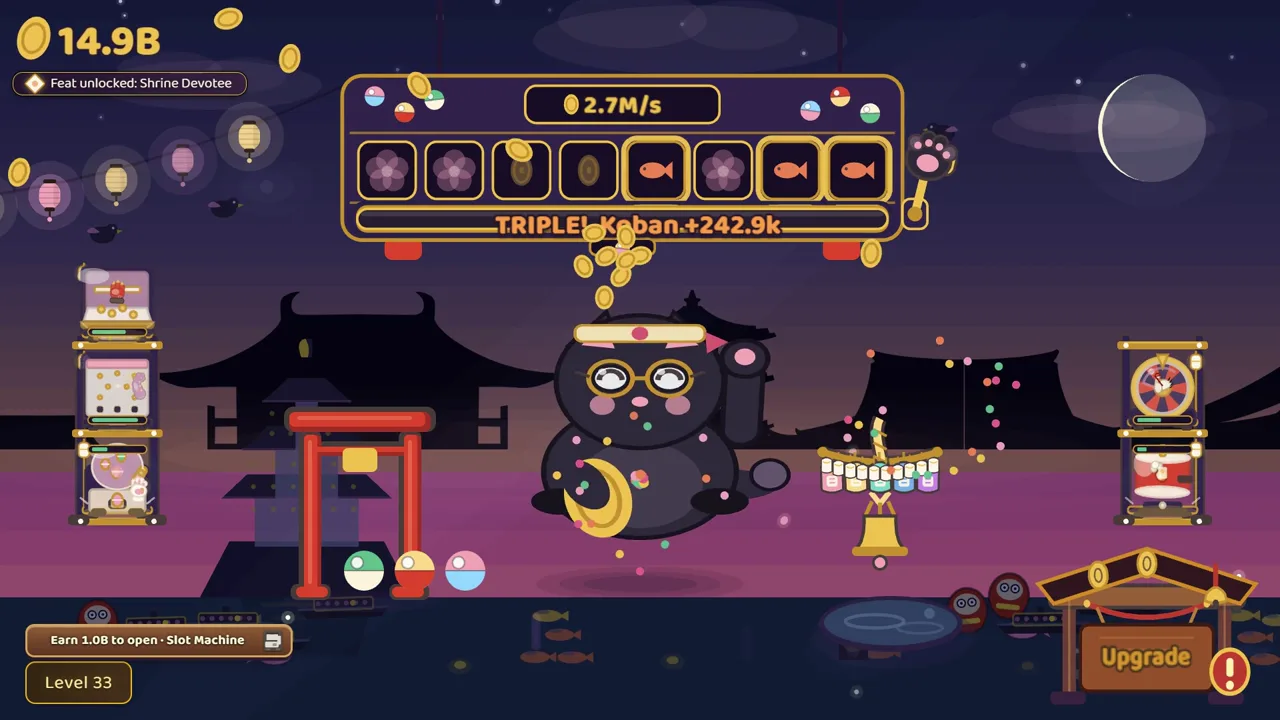
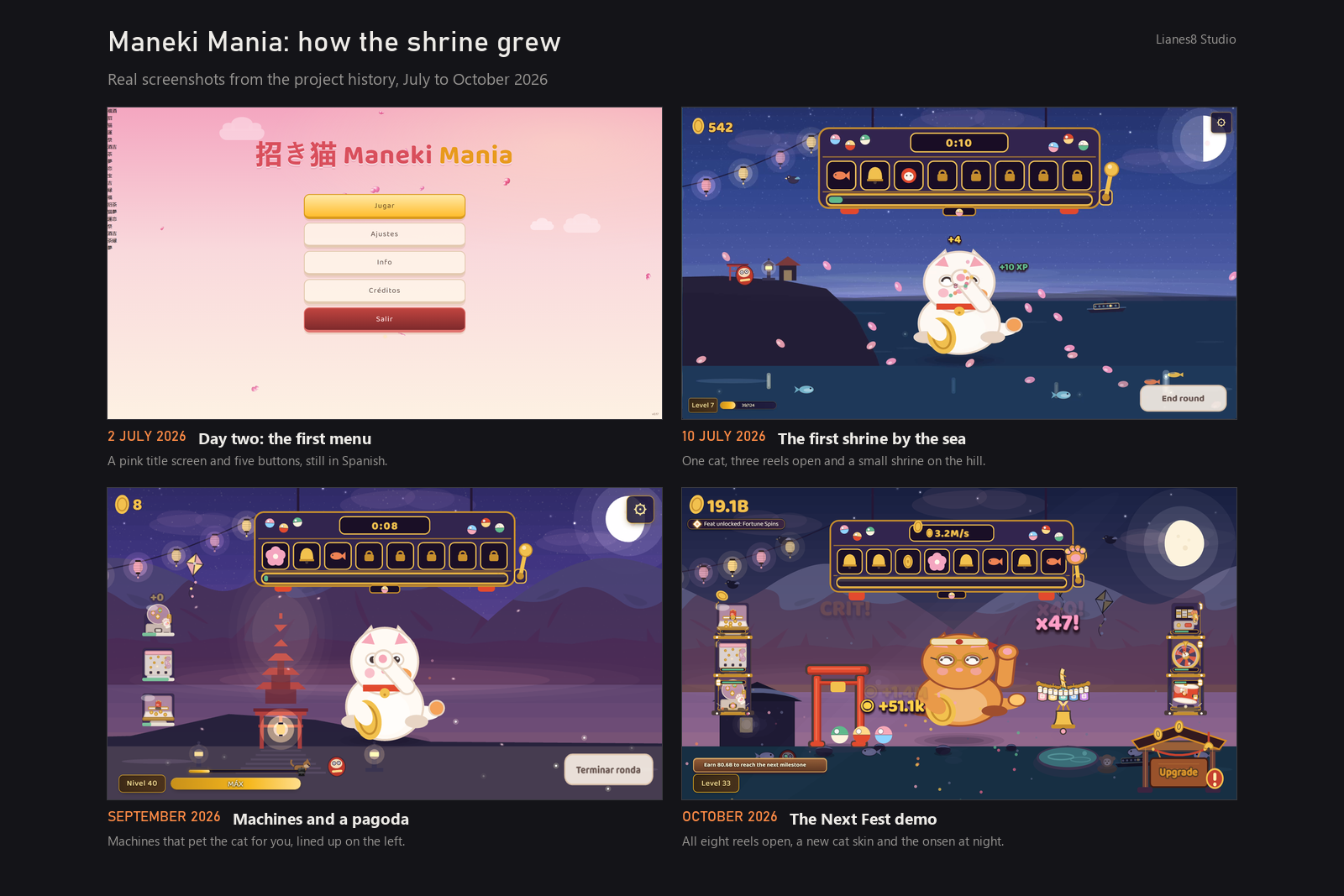
The idea was simple: a calm shrine where you like to be, and the reels as the little rush. You pet the cat to earn koban, the fortune meter fills, and then the charm slots spin for pairs, triples and the koban jackpot. Everything is in-game coins only, there is no real money anywhere. With time you build machines that pet the cat for you, and in the end they do most of the work. But I didn’t want a game where you just sit and watch, so there is always something on the map asking for your hand: boats to tap, people and little characters you can grab and throw, fish, kites, lanterns. The shrine also travels, from cherry blossoms to a snowy onsen at night, so the place changes as you grow. All the art is hand-made: a big white lucky cat in the middle, the reels hanging above it, paper lanterns, torii gates and a night sky with the moon. For the Steam capsules I work with an artist I found on Fiverr, Javier Heredia.
Pidgeon Pocket has a very different setting and personality. What design lessons did you carry across between the two games, and what did you intentionally do differently?
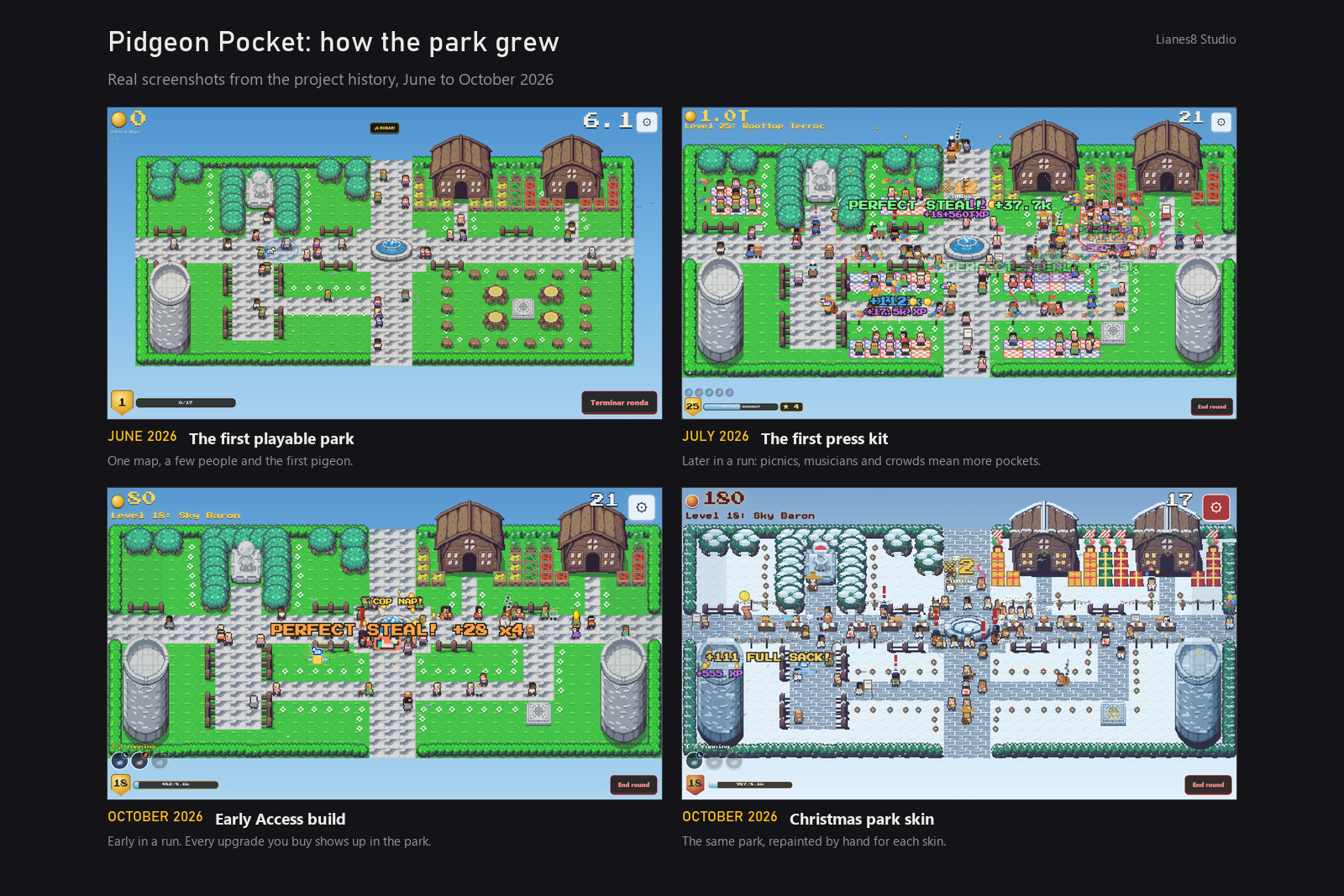
Pidgeon Pocket is more of a heist. The pigeons and the people are my own pixel art, and the park tiles started from a free CC0 pack that I repainted. You aim your pigeons at people in the park, steal, and get out before the police close in, and the police get smarter the more you steal. Every round the park changes too, with live events like a marathon, a street parade, a market, a concert or a dog show. The biggest lesson I carried between the two games is that a number on its own is not a reward. If you buy an upgrade, you need to see it and hear it. In Pidgeon Pocket that became a rule for me: every step of the upgrade tree has to show up in the park, and every pigeon now has its own superpower that you can actually see, like a pigeon flying fast with its own sprite. Maneki Mania got the same treatment, with machines and characters that appear on the map as you grow. What I did differently on purpose is the feeling. Maneki is cozy and you can play it with one hand while you relax. Pidgeon is a bit sneakier and asks you to choose your targets and build a squad, with up to five pigeons, 20 superpowers and level eggs where you pick between a new power, a level up or a bag of coins.
Incremental games need a satisfying balance between quick rewards and longer-term motivation. How do you approach pacing, progression and player feedback when working alone?
For me the most important tool is a small simulation that plays the game by itself. I built one for Maneki Mania, and I use it every time I touch a number, because when every system is simple, every number matters a lot. Once I changed a single multiplier from 1.09 to 1.045 and the full game got about half an hour longer. But I also learned that a simulation always plays better than a real person. Real players stop, look around, miss things. So the simulation tells me where things break, and real play sessions tell me how it feels. The goal I try to keep is simple: something new should happen every few minutes, there should be no long stretch where you have nothing to buy, and money should always have something to go to. Then it is a lot of playing, changing one number and playing again.
How has releasing demos and taking part in Steam Next Fest shaped either game’s development? Has any player feedback genuinely surprised you?
A lot. Pidgeon Pocket has had a free demo since July, and the real reviews were very honest: it felt slow, a bit repetitive, money was hard to get and there were moments where nothing happened. I also watched a streamer play without stopping for three hours, and they got stuck at a point where it was really hard to earn money. That changed the game a lot. It led to the biggest update it has had, with a superpower for every pigeon, the level eggs, and an upgrade tree where every step is visible in the park. With Maneki Mania there was one review on Steam, written in Chinese, that was spot on: gold was piling up with nothing to spend it on most of the time, and every player ended up with the same talents. That player was right, and I reworked the tree and the economy because of it. Steam Next Fest is great for this, because suddenly many different people play the game, and I can only test it my way.
What has been the biggest practical challenge of developing, testing, promoting and supporting these projects independently?
Doing everything at the same time. I build the games on my own engine, which took years of headaches, and I also do the testing, the store pages, the trailers, the translations into 31 languages and the support. Testing is the hardest part, because I only play the game the way I play it, and I don’t have every device. For example, I don’t have a Steam Deck, so I really need players to tell me how it runs there. That is also why I build my own tools: the simulation for balance, and for Pidgeon Pocket a map editor where I build the park by hand, place every tree, path and prop, and the game reads it exactly as I leave it.
With Maneki Mania’s planned early-access launch on 3 December, what are you most excited to share next, and what would you like players to understand about Lianes8 Studio?
Maneki Mania comes to Early Access on PC on December 3, and version 1.0 is planned for February 4, 2027. For 1.0 the focus is mostly performance and balance, with everything players tell me during Early Access. Before that, Pidgeon Pocket comes to Early Access on Steam on November 9, with 1.0 planned for January 7, 2027, and after launch I want to spend time on a real hard mode and on what the community asks for. Both games have free demos on Steam, and Maneki Mania is already out on Android. About Lianes8 Studio, I’d like players to know that it’s just one person in Spain who makes the whole game, end to end, and who listens to the players. If you find a problem or you have an idea, tell me. I’ll read it, and if I can fix it, I will.
Discover both games
Maneki Mania is targeting Steam Early Access on 3 December 2026, with a free demo available. Pidgeon Pocket is planned for Early Access on 9 November 2026. Dates are the developer’s current plans and may change.
Interview answers supplied directly by Javier Lianes García to Coloured Static Press, 25 October 2026. Developer-provided statements are attributed; this is not a hands-on review. Official imagery used with editorial permission.