
COLOURED STATIC PRESS / HANDS-ON PC GAME REVIEW
There are jobs that offer stability, a decent pension and occasional biscuits. Then there is the career offered by Coins Must Be Made, in which you stamp goblins into loose change and a king repeatedly turns up to demand the proceeds. It’s a deeply unreasonable workplace, and unexpectedly hard to leave.
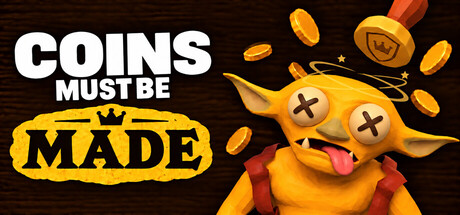
Have you ever wondered what it would be like to earn a living by repeatedly flattening goblins into gold coins? No? Well, neither had I, but apparently that’s exactly the career I’ve found myself pursuing in Coins Must Be Made. And to make matters worse, there’s a rather greedy king demanding increasingly ridiculous amounts of my hard-earned money! At first glance, Coins Must Be Made looks like a fairly simple game, and mechanically, it is. You’re presented with a giant hand and a selection of unfortunate little goblins waiting to be turned into currency. Your attacks happen automatically, so all you really need to do is use your mouse to aim at your next victim. Each successful hit brings you closer to flattening a goblin, rewarding you with coins when it’s defeated. There’s something ridiculously satisfying about watching these little creatures get stamped into money, especially with the wonderfully comical “ba-doong!” sound effect accompanying the action. However, your hand isn’t capable of working indefinitely. Every attack uses stamina, and once you’ve exhausted it, your shift ends. You’re then presented with a breakdown of your performance, including your accuracy, earnings, number of goblins defeated and other statistics. This creates a surprisingly enjoyable challenge. I regularly found myself wondering just how many goblins I could successfully flatten before my poor wrist decided it had suffered enough!
Goblins, upgrades and a surprisingly satisfying shift
The coins you earn can be spent on upgrades, which is where the game really began to capture my attention. There’s a skill tree offering improvements such as increased attack speed, additional damage and extra stamina. As you progress, more possibilities become available, allowing you to gradually improve your goblin-squashing abilities. You also unlock different goblins, discover permanent collectibles and receive choices between additional bonuses that can alter your approach to each shift. The goblins themselves introduce further challenges as you progress. Some are considerably tougher than others, requiring repeated hits before they finally surrender their coins, while others move much more quickly. The speedy red goblins were particularly entertaining, darting out of the way just as my giant hand came crashing down!
When an upgrade makes things worse
Unfortunately, the automatic attacks occasionally work against you. Certain upgrades provide chances to deal additional damage or eliminate other goblins simultaneously, which sounds fantastic until your hand continues stamping where a goblin has already disappeared. This can result in accidental misses before you’ve had time to redirect your mouse, affecting your accuracy despite the upgrade supposedly helping you. It’s a relatively small frustration, but one that becomes increasingly noticeable as your abilities improve. There’s also a shop offering different stamps and workshop improvements. These provide additional ways to improve your performance and earnings, including increased critical hit potential, better chances of valuable loot and equipment that helps keep your minting table supplied.
The variety of purchases adds another enjoyable element to the progression system, although some items come with enormous price tags. Shop purchases also don’t carry over into subsequent cycles, meaning you need to consider whether they’re worth buying when your current contract is nearing its end.
Long live the king, and his accounting department
And then there’s the king. Oh, the king! Apparently, His Majesty believes that because I’m earning money by repeatedly hammering goblins into the floor, he’s entitled to an increasingly enormous share of it. Every few shifts, you’re presented with another royal tax bill. Initially, the demands are relatively manageable, but as you progress, the amounts become increasingly outrageous. What started as a small payment eventually escalated into demands for thousands, then tens of thousands, of coins. At one point, I was being asked for 65,000! The problem is that the goblins become significantly tougher as well. Sometimes you can spend practically an entire shift working on one particularly stubborn creature, leaving you with very little to show for your efforts. There’s even a moneylender available if you find yourself struggling financially, although borrowing comes with its own consequences, including a percentage of your earnings being deducted. At first, I found the enormous tax increases rather excessive. It felt as though the game was demanding more money than I could reasonably earn, particularly when the tougher goblins were taking so much longer to defeat. However, after a little experimentation, I began to understand what appears to be the intended progression system. When a contract ends, you can begin another cycle. Paying royal taxes earns prestige points, which can be used to purchase rings that provide permanent bonuses for future contracts. These can improve your strength, stamina and other abilities, giving you a much better chance of progressing further on subsequent attempts. I discovered this rather dramatically after realising I’d been playing with only one ring equipped when I could actually equip several! Once I’d taken advantage of those permanent improvements, the difference was noticeable. My fourth cycle felt significantly easier, and I was earning considerably more money than during my earlier attempts. There’s even an incentive to pay certain royal taxes early, with additional bonuses such as increased attack speed being offered for prompt payment. This makes the initially frustrating difficulty curve more understandable. Rather than expecting you to keep up with the king’s demands indefinitely, the game encourages repeated attempts, allowing you to return stronger and gradually work your way towards bigger achievements. That said, the balancing can still feel rather harsh, particularly when your current earnings fall dramatically behind the enormous tax bills. There’s also the option to gamble your earnings on a coin flip after a shift, potentially increasing your winnings at the risk of losing your stake. Naturally, I had to investigate this feature for research purposes. I lost 175 coins.
Needless to say, I decided that honest goblin-squashing was a considerably more sensible career choice! Visually, Coins Must Be Made embraces its absurdity. The goblins have amusing little appearances, the enormous stamping hand looks wonderfully ridiculous, and the overall presentation suits the game’s quirky sense of humour. The music has an old-fashioned, lute-style sound that complements the medieval setting, while the comical effects accompanying the goblin-flattening provide much of the entertainment. What surprised me most was just how invested I became in something with such straightforward gameplay. It wasn’t simply the satisfaction of squashing goblins that kept me playing. It was the constant opportunity to unlock something new, improve my abilities, discover another creature or see whether I could beat my previous performance. Even when the tax demands started getting ridiculous, I wanted to find out whether my next cycle would be more successful.
The goblins have a terrible day, the king enjoys an excellent one, and somehow we are the people expected to pay taxes.
Final thoughts
Coins Must Be Made takes a wonderfully ridiculous premise and turns it into a surprisingly engaging progression-based experience. Its simple controls make it easy to get started, while the skill tree, unlockable goblins, shop equipment, collectibles and permanent upgrades provide plenty of reasons to keep returning for another round. The increasingly difficult enemies and enormous royal tax demands can make progression feel unnecessarily punishing at times, while certain upgrades can unintentionally interfere with your accuracy. However, the cycle-based progression helps offset those frustrations, rewarding repeated attempts with permanent improvements that make a noticeable difference. It’s colourful, comical and oddly satisfying, with enough upgrades and unlockables to keep players like me happily occupied. I thoroughly enjoyed my time flattening goblins into gold, even if I did spend a considerable amount of it questioning why the king deserved such an enormous share of my earnings.
Final verdict: 82/100
Coins Must Be Made turns a ludicrous premise into a satisfying cycle of goblin-flattening, upgrades and increasingly unreasonable royal bills. The progression is more compelling than its simple controls suggest, although automatic attacks can hurt accuracy and later demands make the grind punishing. An amusing little addiction, even if the king insists on taking most of the profits.
Where to find it: Official Steam listing. The PC game released on Steam on 28 October 2026, and a free demo is also available.
Based on original PC hands-on gameplay observations and the original 82/100 verdict supplied to CSPress. The image is official developer artwork, not a simulated gameplay capture. Editorial polish and additional context by the Coloured Static Press team. Review by the Coloured Static Press team.