

Game Review / Live-Action Mystery / Story-Driven Adventure
A missing-person mystery, seven intertwined lives and some of the most striking live-action presentation we’ve seen in a story-driven game. AKIBA LOST is beautiful to look at, occasionally heartbreaking and, more importantly, full of people we genuinely came to care about.
There are games you finish and immediately start thinking about their mechanics, their performance or the things you would change. Then there are games that leave you thinking about the people in them.
AKIBA LOST falls firmly into that second category. We loved our time with it, not simply because it knows how to keep a mystery moving, but because the characters give that mystery its weight. It’s stylish, ambitious and at times surprisingly emotional. Underneath all the dramatic twists and polished live-action scenes is a story about absence, unresolved grief and the people who keep living around it.
And while we could happily spend this entire review telling you how lovely the game looks, that would be doing it a disservice. Its greatest achievement is making its cast feel like more than a collection of names on an increasingly worrying flowchart.
Thirteen years, six disappearances, and a dangerous idea
Developed and published by IzanagiGames, AKIBA LOST takes place in Tokyo’s Akihabara district. Thirteen years before the story begins, six girls vanished in a case that was never solved. The incident, known as the Akiba Vanishing, cast a long shadow over those left behind.
One of them is Daiki Shinjo, a once-celebrated game creator whose younger sister Ruri was among the missing. With his professional fortunes fading and the case still unresolved, Daiki announces a new game based on the disappearances. The hope is that bringing the mystery back into public view might finally turn up answers.
It’s an audacious starting point, and not an especially comfortable one. Turning a real tragedy within the story into entertainment raises questions about motivation, responsibility and the price of trying to make the past visible again. AKIBA LOST doesn’t need to lecture the player on those ideas. They’re already built into the premise.
Then the situation gets worse. A threatening phone call arrives, Daiki’s sister Aoi disappears, and the fictional events being prepared for the game begin to echo what is happening outside it. Suddenly, a troubled production has become something much more serious.
That’s as far as we’re going with the plot. This is a game best approached with as little advance knowledge as possible, and explaining how its various threads eventually connect would rob you of much of the pleasure.


The mystery unfolds through a series of striking live-action scenes. Original gameplay captures by Coloured Static Press. Select an image to view it at full resolution.
The characters are the reason this works
It’s tempting to talk about the twists in a mystery like this first, but the cast deserves the attention. Daiki may provide the central motivation, yet AKIBA LOST isn’t content to make everyone else orbit his story.
Alongside Aoi, the narrative brings together game streamer Yukimi Kurahashi, gourmet writer Moe Kurosu, underground idol Kokone Nagato, shrine maiden Chihiro Jimbo and cosplayer Wakana Yusa. On paper, those descriptions could sound like a tour of Akihabara stereotypes. In the story, they’re entry points into people whose situations, relationships and concerns matter in their own right.
That distinction is everything. A mystery can be clever and still feel strangely empty if its characters exist only to deliver the next clue. Here, the emotional pull comes from wanting to understand these people, not merely from wanting to solve an elaborate puzzle about them.
We found the characters especially strong, and the performances do much of the heavy lifting. Their individual stories bring warmth and personality to what might otherwise have become an almost relentlessly bleak experience. There is room for lighter exchanges and eccentric supporting characters, but the humour never makes the underlying losses feel trivial.
When the game slows down and allows a relationship, a difficult conversation or an old wound to take centre stage, it can be genuinely affecting. Those quieter moments give its bigger dramatic turns something to build on. Without them, another sudden disappearance would be just another plot development. With them, it matters.
That’s why we would urge people to give this one a chance even if they don’t usually reach for live-action games or visual novels. The performances have a persuasive, human quality that reaches beyond the genre label.


The people at the centre of the mystery are what make AKIBA LOST so compelling. Original gameplay captures by Coloured Static Press. Select an image to view it at full resolution.
Seven perspectives, one mystery
The cleverest structural decision in AKIBA LOST is allowing the story to unfold through multiple viewpoints. Rather than keeping the player permanently attached to one protagonist, the game lets you move between the central characters and see how events develop across the same stretches of time.
That doesn’t simply mean repeating a scene with a new face in the foreground. The idea is that each person carries a different piece of the wider situation, and what happens in one route can affect how another proceeds. Sometimes an apparently blocked storyline needs something to change elsewhere before it can move forward.
The game calls part of this system FREEZE & ACTIVATE. A route may stop, leaving you to work through another perspective to find the connection that opens it again. Choices and the branching timeline turn the story into a kind of narrative jigsaw. You’re not just watching several lives unfold; you’re learning how they fit together.
That gives the player an enjoyable role in an otherwise heavily scripted experience. The challenge isn’t one of reflexes or complicated controls. It’s about paying attention, remembering who knows what and recognising the consequences of a decision in the wider picture.
There’s an appealing sense of discovery when a thread starts to connect. The overall mystery becomes more interesting as you see how much somebody else’s apparently separate day might matter. In a game full of disappearances, the most important thing can sometimes be making sure the right person turns up in the right place.
It also means the story rewards patience. You’ll spend far more time reading, choosing and observing than carrying out conventional videogame actions. That is very much by design, and it is worth knowing before diving in. If you are expecting a fast-moving action thriller, this isn’t one. If you enjoy stories that let you work out their structure as you go, there’s plenty to appreciate.


Choices and multiple perspectives keep the story moving in unexpected directions. Original gameplay captures by Coloured Static Press. Select an image to view it at full resolution.
Simply beautiful to look at
We were taken with the presentation. AKIBA LOST is a genuinely beautiful game, although perhaps not in the way that phrase is usually used. It isn’t about enormous landscapes or elaborate particle effects. Its beauty is in photography, lighting, composition and the expressive faces of real performers placed at the centre of the experience.
The game combines a huge number of live-action still photographs with filmed sequences. That could easily have looked awkward, a slideshow periodically interrupted by television drama. Instead, the production has a visual confidence that makes the format feel deliberate and distinctive.
IzanagiGames worked with Nippon Television and AX-ON, and that collaboration shows in the care given to the scenes. The camera often has the luxury of simply observing someone rather than rushing to the next moment of action. A shift in expression, a pause before an answer or the way a location is framed can carry as much atmosphere as another line of dialogue.
It’s particularly effective in a mystery where the player’s job is to pay attention. The characters are not abstractions or tiny portraits tucked into a corner of the screen. They are present, recognisable and capable of communicating emotion through more than the script alone.
Akihabara itself is an inspired setting. Maid cafés, idol culture, cosplay, streaming and the area’s wider creative scene give the cast very different connections to the same place. There is affection for the district here, but it isn’t merely a neon backdrop. It is the social landscape that allows these lives to intersect.
For a title that spends much of its running time asking us to look at still images, the sheer visual richness is remarkable. It proves that a game doesn’t have to be constantly moving to hold your attention.
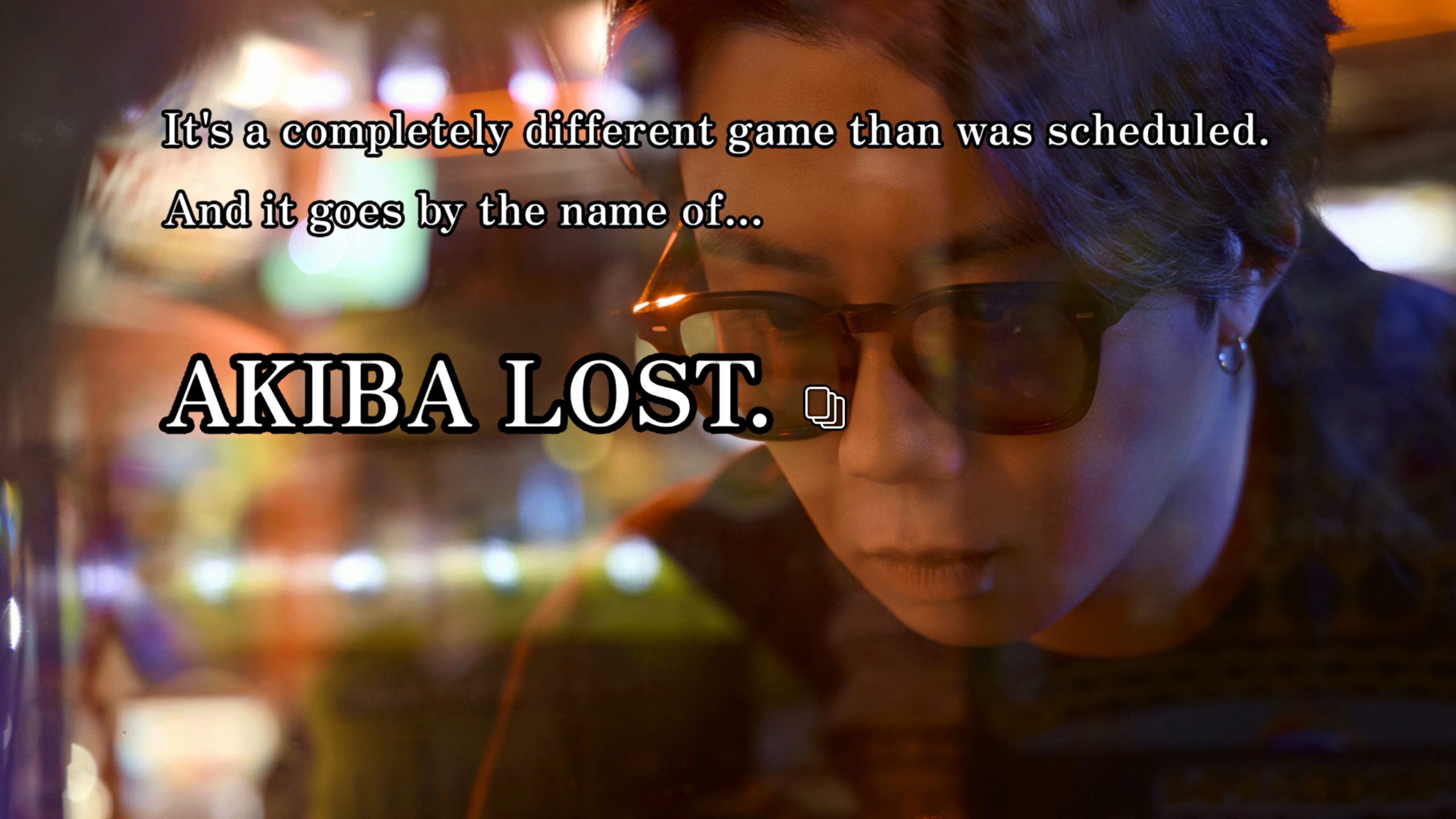
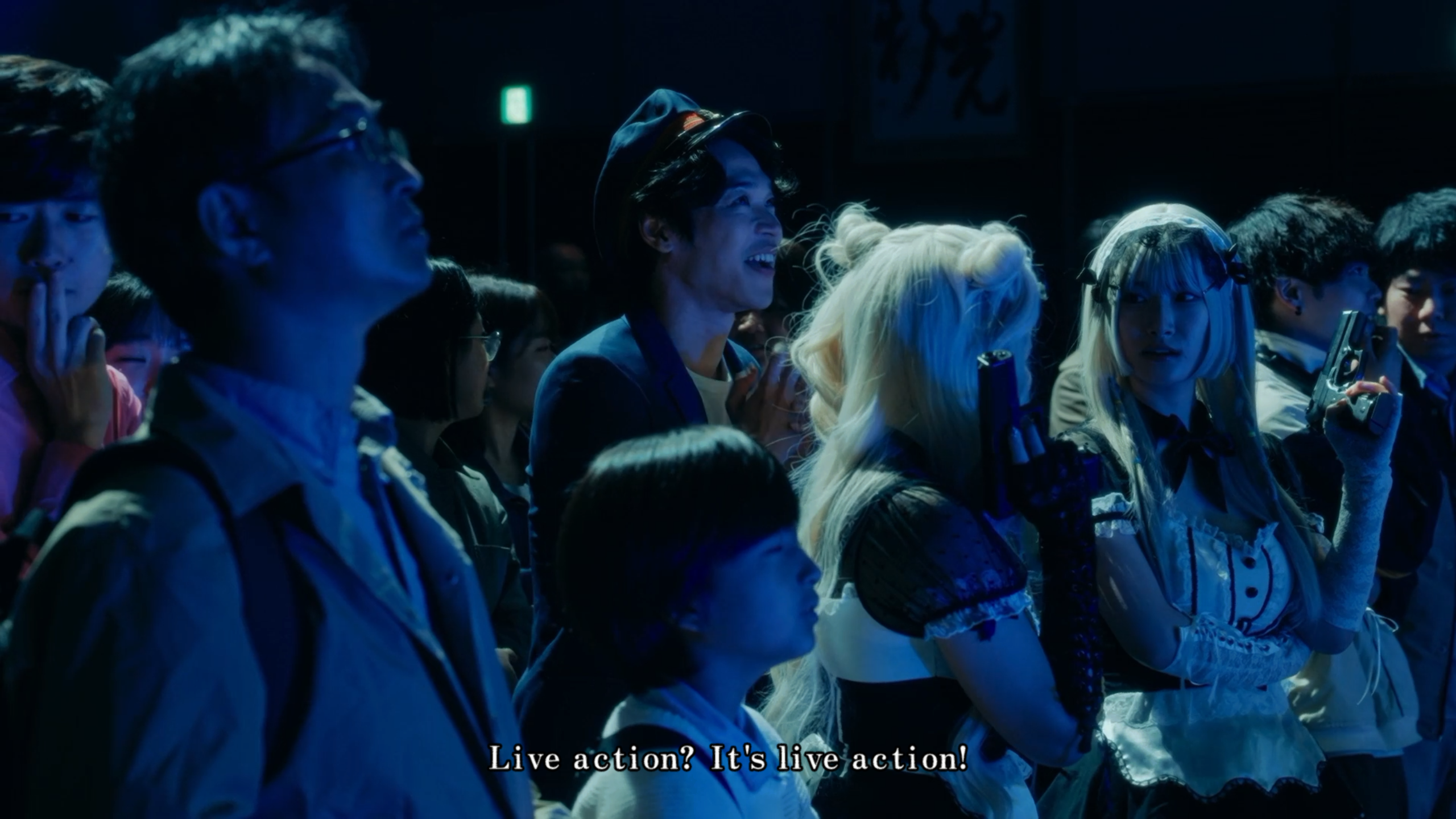
AKIBA LOST’s live-action photography gives its world a distinctive visual character. Original gameplay captures by Coloured Static Press. Select an image to view it at full resolution.
The emotion is what stays with us
What impressed us most wasn’t any single piece of storytelling machinery. It was the way an entertaining suspense premise repeatedly finds its way back to something personal.
The disappearance at the centre of AKIBA LOST isn’t just a mystery to be explained. It’s something that happened to families, to relationships and to the people who have had to spend years living without certainty. That changes the emotional temperature of the story. Solving a case might satisfy your curiosity, but understanding what the uncertainty has done to somebody is a different thing entirely.
We won’t identify the scenes that hit hardest. The game deserves to deliver those in its own time. Suffice it to say that there are moments of real tenderness amid all the suspicion, and the characters are compelling enough for those moments to land.
That human quality also helps when the narrative becomes more elaborate. A story with this many players, paths and revelations is always in danger of disappearing into its own cleverness. Strong characterisation provides an anchor. Even when you’re juggling multiple pieces of information, the fundamental question is wonderfully simple: what is going to happen to these people?
It’s the difference between wanting to reach the ending and caring about how everybody gets there.
Not every part of the mystery moves at the same pace
For all our enthusiasm, there are reasons AKIBA LOST stops at 85 rather than climbing into the nineties. Its greatest structural strength also introduces some friction.
Following multiple perspectives means that information occasionally overlaps. A scene that feels revealing the first time can have less impact when revisited from another route, and tracking down the right point to unlock a frozen thread can briefly interrupt the dramatic momentum. The branching structure is clever, but it doesn’t always remain invisible.
Similarly, this is much closer to an interactive television mystery or substantial visual novel than a traditional adventure game. There are choices, timelines and some 360-degree sequences in which you can look around a scene, but much of the experience is spent absorbing the story rather than actively manipulating a world.
None of that is a flaw in itself. It does, however, ask the audience to meet the game on its own terms. Those coming from action-heavy releases may need to adjust expectations. And even among people who enjoy narrative adventures, some of the route management is less elegant than the drama surrounding it.
The story’s ambition can also make its larger revelations feel rather busy. When you build a mystery with so many interlocking elements, keeping every transition natural is a difficult balancing act. A slightly tighter approach to certain repeated beats would have allowed its finest emotional scenes to breathe even more.
These are meaningful limitations, but they never eclipsed what we loved most: the cast, the production and the investment the game builds in its characters. We came away wanting to recommend it, not make excuses for it.


A selection of moments from our time with this memorable narrative mystery. Original gameplay captures by Coloured Static Press. Select an image to view it at full resolution.
Who should play AKIBA LOST?
If you love story-driven adventures, branching mysteries or the sort of drama that invites you to spend the evening saying “just one more chapter”, this is an easy recommendation.
Fans of live-action games have an obvious reason to be interested, but we don’t think the audience needs to end there. AKIBA LOST has enough charm, warmth and emotional substance to reward players who are curious about the format, even if they have never played one before.
The one thing we’d strongly suggest is approaching it without too many spoilers. Its best moments depend on the accumulation of information and the relationships you develop with the cast. Knowing the destination before starting would take away part of the journey.
It also deserves time. Don’t come to it expecting to finish an investigation between two quick matches of something else. Settle in, pay attention and let the people and their stories do their work. The game is considerably better when you give it that space.
Final verdict
A beautiful, deeply engaging live-action mystery whose characters give every twist a reason to matter. AKIBA LOST captivated us with its striking presentation, accomplished performances and moments of genuine emotion. Its interlocking perspectives are inventive, even if repetition and some awkward progression occasionally slow the story. Those rough edges don’t change how strongly we feel about it.
We loved this game. More than that, we want other people to discover why. If the idea of a story-led mystery appeals to you even slightly, we genuinely urge you to try AKIBA LOST. Give it a chance to introduce its characters, and there’s every possibility you’ll find yourself as attached to them as we were.
Memorable, emotionally convincing characters; impressive live-action photography and performances; an absorbing central mystery; inventive multiple-perspective storytelling; wonderful sense of place.
Repeated scenes can interrupt momentum; some route unlocking requires patience; relatively limited conventional gameplay; occasionally overcomplicated plotting.
Where to play: Steam (PC) · PlayStation 5 · Nintendo Switch 2. Also available for Nintendo Switch. Japanese voice performances with English subtitle support.
Review notes: Original editorial opinion and 85/100 assessment from the Coloured Static Press team. Game details were checked against official publisher and storefront information. This review avoids major story spoilers. All screenshots are genuine gameplay captures supplied by Coloured Static Press, not AI-generated artwork.