
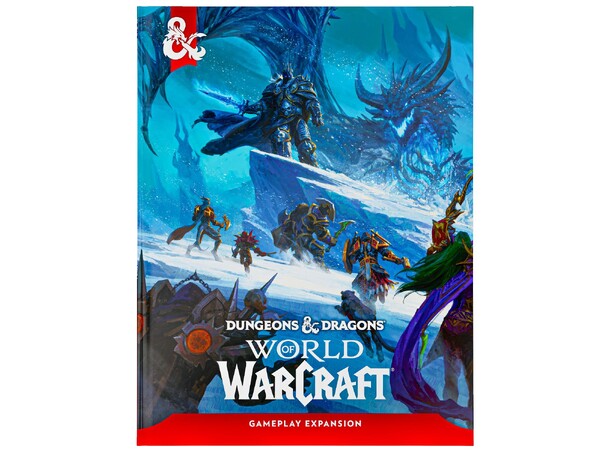
TABLETOP · OFFICIAL LAUNCH / COLOURED STATIC PRESS
Thirteen classes, sixteen playable species and seven familiar dungeons. Wizards of the Coast is bringing twenty years of Azeroth to a dining table, with significantly fewer loading screens.
There is a particular magic to World of Warcraft that numbers alone have never explained. The first time you wander somewhere you really should not be, the guildmate who saves a doomed pull, the heroic plan that collapses immediately because someone has decided to investigate a suspicious crate. It has always been a world built as much from shared disasters as epic victories.
That is why today’s wide release of Dungeons & Dragons: World of Warcraft, developed with Blizzard Entertainment, feels like a more promising crossover than a simple collection of licensed artwork. D&D and WoW already speak many of the same languages. The challenge is whether an expansion can let people tell new stories in Azeroth instead of trying to recreate a computer game with dice.
What is actually included?
The official expansion supports all 13 World of Warcraft classes, including nine new or revised subclasses and more than 40 specialisations. There are 16 playable species, 11 of them newly added for the crossover, as well as more than 60 spells, at least 25 magic items and a substantial collection of factions, creatures and campaign hooks.
For Dungeon Masters, the headline attractions are seven adapted dungeons, including the Deadmines, Scarlet Monastery, Onyxia’s Lair and Shadowfang Keep. The bestiary brings more than 50 monsters and 30 dungeon-boss stat blocks. A separate Icecrown Citadel adventure map pack provides a high-level finale involving the Lich King, rather than being included as a free chapter in the standard book.
The main expansion is available in digital and physical forms, with optional bundles, maps, a screen and collectors’ material. Local game store early access began on 3 November; the wider release is Tuesday 17 November 2026. Check individual retailers for availability and exact bundle contents before buying; the lavish versions are not interchangeable with the standard gameplay expansion.
An MMO’s greatest strength is already tabletop’s greatest strength
The most interesting possibility isn’t recreating a boss encounter move for move. It is allowing a party to change a familiar story. What if the group’s paladin refuses a supposedly noble quest? What if the rogue finds a diplomatic solution to a dungeon that, on a screen, has mostly existed to be cleared? What if a guild finally gets to negotiate with an orc instead of memorising the optimum route to the loot?
A tabletop system can spend an evening on a conversation that an MMO might reduce to a yellow exclamation mark. That’s not a criticism of World of Warcraft. It is the advantage of putting a human Dungeon Master, rather than a server, in charge of the consequences.
Who should pay attention?
Long-time Warcraft players have obvious reasons to be curious, particularly groups who already know the world and want a fresh use for it. D&D groups without a WoW background may find the lore dense, though the familiar fantasy building blocks should help. Newer players should also remember that this is an expansion built on the contemporary D&D rules, not a complete standalone replacement for every core rulebook.
We haven’t run the book at the table yet, so this is a launch feature, not a hands-on verdict. What we can say is that the material appears to understand the appeal of Azeroth: exploration, friendship, class identity and the possibility that a sensible plan will go horribly wrong somewhere near the third door. Personally, I’d call that a remarkably faithful adaptation.
Sources and further reading
Official D&D World of Warcraft showcase · D&D Beyond contents guide · Wizards Play Network release details